Wednesday, May 18, 2005

The Unorganizd Militia II

TM Lutas of Flit TM whose posts on the Unorganized Militia prompted writing my the previous post on the Unorganized Militia post sent an Email with some very pertinent comments.


I'm working through the source material right now but I think you haven't captured the reality of the thing. If the people are sovereign, they must, at some level, have the right to violence. I challenge you to construct a meaningful construction of sovereignty without it. At the same time, if we are not to have anarchy, such violence must be restricted and channeled in a reasonable way. I submit that the idea of an unorganized militia is an appropriate form for channeling and molding the necessary recognition that the people themselves have the right to do violence if they are to remain sovereign.

Thus it is not correct to say that the unorganized militia is not a part of the common law except insofar as the label itself seems to be of relatively recent vintage. The map is not the country and the label is not the thing itself. Sovereignty is meaningless without violence. Now normal people don't talk of such things on a regular basis. They are left between the lines, implicit and hopefully never used as there is no need. Those who tend to discuss this as a day to day affair tend, as a real world observation, to be obsessed nuts. That doesn't mean that they are in error, merely grossly counterproductive to their cause.

My wife doesn't generally bring up the topic of surgical removal of fingernails at mealtimes unless it is apropos of something that is mealtime conversation. That doesn't mean that she doesn't know how to do it or, when called for, will do it. Popular sovereignty and its attendant right to violence are similarly not for everyday conversation. It's also unrealistic to assume that government will be particularly eager to recognize the fact that it's not ultimately in charge in the US system.

The militia law, I would suggest, is a governmental attempt to restrain and channel this inherent right of a sovereign people to ultimately defend their lives, property, and liberty. Like a police choke hold, restraint in moderation is entirely of a different character than when it goes overboard, and results in death. There are rules for police choke holds and there are restrictions on the ability of the state to restrain the militia. In the US case, the regulation of the "choke hold" is in the text of the 2nd amendment, something that I find astounding that you did not include in your analysis. The entire bill of rights was written to prevent a government run amok from running roughshod over the rights of the people. Any assertion that militia are only creatures of the state have to at least confront the 2nd amendment. You have not done so. You may wish to correct that.


It would seem to me that reality of the thing is there are two issues. They are somewhat entwined because of their history but they should be considered separately. First is the right of people, individually and collectively to defend themselves. The second issue is what is the Militia? I think TM's disagreement is over the second issue. We seem to agree on the importance of the first.

If the people are sovereign, they must, at some level, have the right to violence. . . At the same time, if we are not to have anarchy, such violence must be restricted and channeled in a reasonable way.

Correct. They form a government. If the country is invaded and government does not or is incapable of defense, the citizens have the right to rise as a levee en masse. If the government becomes oppressive they have the sovereign right to remove it. Neither of which depend on the Militia, and exist even when there is not a militia.

The first function of government is the collective defense of its population against violence, foreign and domestic. And ironically, since governments end up with a virtual monopoly on the instruments of coercion, a government can be the biggest threat to the people it is supposed to protect.

The militia never included every one, for example women, but women also have the right to self-defense. Exercising rights to self-defense does not require a militia. TM sent me a link (see comments in the orgianal post) about Condolizza Rice’s father and friends patrolling their neighborhoods with personal weapons to protect against racist violence. They were individuals not a militia. But they were exercising basic human rights.

This is also why the Second Amendment right to keep and bear arms is not dependent on the militia, women have the right to keep and bear arms. The reference to a militia in the Second Amendment is preamble to state a reason why the right is important. Also since originally the Bill of Rights applied to the federal government, it made it impossible for the Federal Government to made an end run around the States duty to regulate the militia by infringing directly on the right to keep and bear.

The protection of basic human rights is dependent on a “democratic” system with a solid respect for the rule of law, that diffuses political power so that no one person or group can get in position to abuse rights. Related to this is a diffusion of the means of governmental coercion, i.e. state and local police instead of a national police force so that no one can control every thing. The militia was a good example of this, even though in theory a single military force its wide local administration made it impossible to use the militia to enforce any laws without wide spread consent. And a reason why, even though the classic militia structures are outdated, a major portion of our defense should rest with the National Guard and Reserves.


The militia is a means for the government to fulfill its duty to protect its citizens.

The militia law, I would suggest, is a governmental attempt to restrain and channel this inherent right of a sovereign people to ultimately defend their lives, property, and liberty.

In addition, I would rather suggest that the Militia system was brought to the colonies as the only economically feasible means of providing for defense. It still remains part of the Governments repertoire to “execute the Laws . . ., suppress Insurrections and repel Invasions.”

it is not correct to say that the unorganized militia is not a part of the common law except insofar as the label itself seems to be of relatively recent vintage. The map is not the country and the label is not the thing itself.

If it can be established that the thing itself existed, this would be a good point. I know of no examples of an “English” militia that exists separately from statutory or executive authority. Except for the American Unorganized Militia I know of no example where people who do not meet for training and have no structure are by design classed as a militia. Militias were always established by an action of the King, a legislature, a Lord or who had the right, or a person acting on delegated authority. Remember the Mutiny Act that made it illegal to raise an army without the permission of Parliament. This was a constitutional/statutory restriction on the Monarchs exclusive power to establish military forces. Up until then this was a purely Royal prerogative provided he had the money. Of course the Militia is not a standing army, even today if a group attempted to establish a militia in England without authority from Parliament they would be prosecuted under the successors to the Mutiny Act.

The Unorganized milita is an administrative category to account for the difference between a constitution that assumes a univeral militia and the fact that there is only a need for a small number of persons training in units. Simply the Constitution reserves to the States the Appointment of the Officers, and the Authority of training. The unorganized milita is a part of the milita that does not have officers appointed or authorty for training. The Congress and legislature provide laws for the calling of the milita. Only two or three states have a law that governns calling the Unorganized Milita, basically, report as individuals at the time and place the governor designates. Without officers, training or a valid way to call them out, the Unorganized Milita is incapable of fufilling the funcitions TM would like. The militia movement organizations cannot be classed as a real milita since the state did not appoint their officers or authorize training.


I think the confusion arises because in our early history there was:

1) A strong distrust of a standing army, given the manner in which the Parliementary and Royal goverments administered, used, and abused the standing army in the 1600’s this was a very reasonable opnion. An opnion reinforced by the Crown’s arbitary use of the Army in the colonies (where the Mutiny Act restrictions did not apply) just prior to the Revolution. Thus the Militia became the model defense organization in the popular mind.

2) The very entwined role of the local militia company in the life of a village blurred the distinction between the governmental establishment of the militia and the nrights of citizens.

3) The American Revolution was a revolt of the Colonies/States against the Crown. Since the militias were controled by the state legislatures, the calling the milita was a natural option. The action of the State Governments in calling the Militia be came confused with indivduals standing up to tyranee.

4) since it is not a topic of every day convesation it is easy for mistaken ideas to take hold.

While entwined in actual use in American history the basic human right of collective self-defense and the organization of the militia are separate things. In the nornal course of things the people exercise their "soverign right to violence" to "ultimately defend their lives, property, and liberty" by forming a governments. In our case the government established by consititutional/statuatory law the militia as one means of exercising this right.

Monday, May 09, 2005

The Unorganized Militia

When the United States was established the founding fathers assumed that the militia would be the backbone of our defense. While it has not worked out that way, the militia clauses are still in the Constitution and law. Many people have a poor understanding what of the militia is, especially the Unorganized Militia. Many assume that the Unorganized Militia is some sort of Common Law structure that exists independent of governmental action, and that consequently citizens can on their own initiative organize themselves as a militia, because they are members of the Unorganized Militia. This understanding has given rise to the so called:”Militia Movement” a series of organizations that have formed themselves to be “militia”. However, this does not agree with the historical record, not is it consistant with intent of the authors of the constitution and laws governing the milita.


To understand the constitution's provisions for providing the common defense, reviewing them is a good place to start.

The US Constitution provides for a Militia. The Congress may establish laws:

Article 2 section 8
Clause 15: To provide for calling forth the Militia to execute the Laws of the Union, suppress Insurrections and repel Invasions;
Clause 16: To provide for organizing, arming, and disciplining, the Militia, and for governing such Part of them as may be employed in the Service of the United States, reserving to the States respectively, the Appointment of the Officers, and the Authority of training the Militia according to the discipline prescribed by Congress;


These clauses assumes that every one knows what a militia is, thus there was no need to provide a definition.

This is different than the Army and Air Force which Congress established on the authority of

Clause 12: To raise and support Armies, but no Appropriation of Money to that Use shall be for a longer Term than two Years;

Title 10 Section 311 b) 2) of the US Code is the enabling statute:

(a) The militia of the United States consists of all able-bodied males at least 17 years of age and, except as provided in section 313 of title 32, [NOTE: members of the regular services] under 45 years of age who are, or who have made a declaration of intention to become, citizens of the United States and of female citizens of the United States who are members of the National Guard. b) The classes of the militia are - (1) the organized militia, which consists of the National Guard and the Naval Militia; and (2) the unorganized militia, which consists of the members of the militia who are not members of the National Guard or the Naval Militia.

It does not state duties or functions of the Unorganized Milita, which must be determined from the legislative history and case law regarding the Militia.

However state laws sometimes provide for three classes of militia. For example:

9‑8‑102 (c ) The Wyoming code defines the States Militia as:

a) The militia of the state is divided into the organized militia and the unorganized militia.

(b) The organized militia consists of the following:

(i) Such elements of the land and air forces of the national guard of the United States as are allocated to the state by the president, the secretary of defense or the secretary of the army or the air force and accepted by the state, hereinafter to be known as the Wyoming national guard; and

(ii) Wyoming state guard forces, when organized.

(c) The unorganized militia consists of all persons liable to serve in the militia but not commissioned or enlisted in the organized militia.


Twenty-five states have State Guard forces.

The Constitution and Federal and State Law authorize a militia, provides for two types of organized Militia and an Unorganized Militia. But there are no detailed definitions in the constitution or law. To see how we got here and what the founders and Congress intended by the different types of militia, we need to look at their historical development.


The Royal Charters for the first Colonies gave them the right to establish militias. These were a continuation of the English Militia system. They were always organized. For each town a company was established and for each county a regiment. Officers were appointed, usually selected by election by unit members, but the commission was from the Governor. Every able-bodied white male between the ages of 16 and 60 was a member, required to provide himself with a suitable musket and equipment. (In modern terms we could say that the Colony was providing for defense by imposing unfunded mandates on the local government and citizens.). After independence the militia continued on the authorization of the state constitutions. After the US Constitution came into effect Congress passed the Militia Act of 1792 providing a common framework for the militia and calling the militia into Federal service. Under this law the President could call a states militia into the service of the United States for 90 days. But this required the permission of the governor, and the militia could not be deployed outside the US. Except for the 90 day requirement these were considered implicit constitutional requirements. When longer terms of service in wartime were required, the President called for volunteers by state who were mustered into the Army (Clause 12 above) as Volunteers. Volunteer army units were often based on militia units.


The company met for muster four times a year. Sometimes a regimental muster would be substituted. If there was a danger of foreign or indian attack the muster could be monthly or in a few cases weekly. If someone did not attend they had to pay a small fine. If they did not have the proper equipment they paid a fine. Muster day consisted of close order drill, musket drill, and maybe some skirmishing practice in the morning. Target practice was seldom done - the militiaman had to pay for their own ammunition. The afternoons were usually a town picnic paid for by the fines of no shows. Families came, and a good time was had by all. If there was a serious danger of attack the afternoon would also be drill and the fines would pay for target practice.

These local Militia companies served several purposes. They provided a rudiment of training, served as a home guard if the town was attacked, and provided a basis for recruiting volunteer forces to help protect other parts of the colony. When a volunteer force was needed, each company would be assigned a quota. If volunteers could not meet the quota the Captain would select who would be drafted to meet the quota. Theoretically the whole unit could be drafted. The few times militia units were drafted for any thing other than home guard duty were usually a disaster (i.e Bladensburg in 1814 and the burning of Washington.)

As the country became more settled, musters, attendance, and even the collection of fines became infrequent and eventually stopped. By the 1840's states were amending their laws to end the muster requirement. Commissions were granted for a time in these non-drilling regiments as a matter of social prestige, after the Civil War so many community leaders had held war service volunteer commissions that a militia commission provided no prestige and the practice was gradually discontinued.

From colonial times there was a different type of militia unit. Often called "volunteer militia." These were completely volunteer organizations that were first organized to provide the high cost units such as artillery and cavalry, often composed of the more prosperous members of the community who provided their own horses and purchased the cannon out of pocket. Later infantry units were organized. From the 1850’s or earlier these were the only militia units that received training. These units provided the backbone of the units that were called up in major wars and are the ancestors of the current National Guard. But because they were militia they could not be called without the permission of the state governor. If volunteer forces were needed for a major war the unit would vote on whether or not to respond, sometimes they voted no. In some places they were excessively involved in local politics. Training was of varying quality. (To confuse the issue some general militia units over time evolved in to volunteer units.)

This is the status at about 1900. On paper, all adult males were members of the militia, but only a small number actually were part of units that met and trained. The laws governing mobilization assumed the original concept of a universal militia. The militia laws also restricted the militia from any useful deployment. The wartime calling of volunteer units was a partial solution not suited to creating a modern Army in wartime. During the first 20 years the last century there were a number of reforms moving the Army out the 19th century into the 20th, The militia reform was an essential part.

The Dick Act (1903) and the 1916 and 1920 National Defense Acts created the basis for the modern Reserve and National Guard units. National Guard units (state militia) received federal funding if they met federal standards and were available for call up. Reserves for the Army that were not part of the state militia were authorized. All able bodied males who are not in regular services or the organized militia are by default members of the unorganized militia. The part of the organized militia enrolled in the National Guard is funded by the federal government, and administered by the states. States could from other militia units at their own expense.

The 1916 National Defense act established the Unorganized Militia is an inactive administrative category to account for the discrepancy between constitutional provision that assumes all able bodied adult males are members of the militia and the fact that current militia organizations are voluntary and only have a small minority of citizens as members.

The 1920 Act made clear that the National Guard was both a state militia (clause 16 above) so it could be called by the Governor as militia for local emergencies, and a reserve of the Army (clause 12 above) so that the President could order it to active duty as a reserve of the Army without the consent of the state governor.

This basic system still governs the organization of the National Guard and Reserves.

The "Militia Movement" is based on the the assumption that the community based milita units described above were created by the local community as an exercise of the rights of the members of the community. In fact (even though largely self administered) they were created on the authorty by the colonial/state governments on the basis of a Royal/Constitutional grant of authority.

Summary:

The “Militia Movement” organizations cannot be real militia since they were not established by law, these are at best gun clubs who like to wear camouflage on the weekends, and at worst violations of the neutrality and other laws.

The concept of an Unorganized Militia cannot be a common law right of citizens to establish their own militias. The militia of all sorts was always established as a delegated Royal prerogative and after 1776 as a legislative/constitutional act of the States.

Since statutory law established the Unorganized Militia in 1916, it cannot be a part of the inherited English Common Law from “time immemorial”.


See Unorganized Militia II


Selected references:

This is an article published in 1917 explaining the 1916 National Defence Act. It has a very good historical overview and what intent of Congress in passing the act. It is especially valuable because it was written before the current controversies.

This is a good modern summery of the militia laws. Note the article says the exact opposite of what one would expect from “Solider of Fortune Magazine” and from the expectations of the target demographic of the that magazine.


See also Arms for empire;: A military history of the British colonies in North America, 1607-1763, Douglas Edward Leach
and
History of the United States Army, Russell Frank Weigley

NOTE: This post started by expanding on comments I made in TM Lutas’s Flit TM (link in side bar) discussing the Unorganized Militia. The post sort of grew and morphed into something rather different.

Saturday, April 30, 2005

Who is a Fascist?

.


[Fill in blank] is a fascist, so don’t listen to what they say.

The argumentum ad hominem is attacking a person rather than the arguemnt they are presenting. It is always invalid on grounds of irrelevance, even if the accusation is true. For example “SoandSo makes that statement because he is a 'gruby worn and a low life'” Even if the accusation is true and SoandSo is a 'gruby worm and a low life', what they said is right or wrong on it’s own merits. SoandSo’s status (true or false) as a 'gruby worm and alow life' is irrelevant to what they are saying.


Since WWII, it seems that everyone’s favorite argumentum ad hominem is the argumentum ad hitlerum. That person is a Nazi or Facist or something similar. It has been used for so long against so many people in so many different situations, unrelated to the historical context, that the term means “someone I don’t like.’ It communcates no real knowledge about the person or what they are saying. Even, on the chance of random probability, it is most likley false. The worst part about this is that there is such a thing as Fascist ideology. Persons supporting this ideology, if they avoid certain keywords, can easly escape recoginiton in all the false claims. The substance of fascist ideas could be presented with differernt terms and not be noticed by the unsuspecting. It would not be surprising for fascists to be loudest in accusing their opponents of being fascists

I went to google to see how wide spread this phenomenon is. I made entries in different comibnations of “Is (was) a fascist (nazi)” to see what I would get. The following is a small sample. This is just items that appeared in the sample text Google displays. To be fair while some are serious, some are humor, and some are defending someone against the accusation, which of course means the accusation was made. Some show much study and thought, some are ignorant and thoughtless.


Dobson is a Fascist
LePen was a fascist
Brigitte Bardot is a fascist!
Hitler was a fascist
To modern-day Leftists anybody they disagree with is a "fascist”

Every Jew-baiter, every Catholic hater, is a fascist
Santa is a fascist!
China is a fascist country
My Tivo is a fascist
Fidel Ramos is a fascist

Peter Singer is a fascist.
Zarqawi is a "fascist"
Heidegger was a professed fascist
Richie Rich is a fascist!
Bill Clinton is A Fascist

Hillary Clinton is a fascist
[Hugo] Chavez is a fascist
Hillary Duff Is A NAZI!
Janie Is A Nazi
Everybody's a Nazi

John F Kennedy was a Nazi
Ted Kennedy is a nazi
[Ward] Churchill is a fascist,
Reno is a fascist,
Castro is a fascist

Saddam was a fascist
Your Dog Is a Fascist
Ezra Pound was a fascist
Bin Ladin is a fascist
Diana Mosley was a fascist

I was a fascist
[Winston] Churchill was a fascist
Roosevelt was a Fascist
Harry Potter is a Nazi
Los Angeles Shooter is a Nazi

Joseph P. Kennedy Sr. was a Nazi
Marx was a Nazi
Stalin was a nazi
Mao was a nazi
Che was a fascist

Heinlein's a fascist idiot
Bobby Fischer is a Nazi
Dean is a Fascist
Al Gore is a fascist
John F. Kerry is a fascist


And Crumpy Blog provides the best comment on the most popular “ is a Fascist (or Nazi)” response


- namely -


“Bush is a Fascist”

. . . I don't like people who pick a political stance because it's in fashion to do so. I saw a person wearing a Bush=fascist shirt. I asked her in a non-confrontational way, "Why do you think Bush is a fascist?" The response was, "Because of the stuff he does". I inquired "what stuff is that?" The response was "the Patriot Act". Playing dumb I asked, "What is the Patriot Act?" She said, "it takes our rights away." When asked what rights does it take away she said, "Freedom of the Press, and religion." OK, at this point I know she didn't know what the hell she was talking about so I simply asked, "What is a fascist?" She again said "Bush." So I said "Besides Bush what is a fascist?" A blank look came over her face. After about 30 seconds I asked her "Well can you give me an example of a fascist other than Bush". Her answer was "the English guy, Mel Gibson, and the guy on the radio". At this point I wanted to see how far I could take it so I asked "How about that guy who lead Italy during World War II....what was his name....Benito Mussolini?" The response I got floored me. "No, he was cool" she said.


I would like to respectfully submit that there seems to be a serious general knowledge problem in the fields of History and Political Science.

Saturday, April 23, 2005

John Bolton and Edmund Burke

One of today’s hot button issues is the nomination of John Bolton as US Ambassador to the UN. “The National Interest” magazine has republished and article written by Mr. Bolton for their Winter 1997/1998 issue: The Prudent Irishman: Edmund Burke's Realism.

The article points out different attitudes regarding US Foreign policy since the fall of the Berlin wall and looks to 18th century philosopher Edmund Burke for suggestions on how to proceed.


In view of the polices of the current administration the first two paragraphs are interesting.

Today, Cold War-era anti-communists argue among themselves--and the disagreements are not about tactics. Let us be frank: some have become near isolationists. Others enthusiastically espouse Woodrow Wilson's view that the world needs to be made safe for democracy and its family of values. Some of the latter seem to long for a new crusade to keep America at the top of its game, if nothing else. Then again there are those who see the world as still dangerous, but far more opaquely so than it was during the clearer days of the Cold War. They seek an interests-based foreign policy grounded in a concrete agenda of protecting particular peoples and territories, defending open trade and commercial relations around the world, and advancing a commonality of interests with our allies.

Finding myself in this third school, I often turn for guidance to that political philosopher whose understanding of the interplay of interests and values remains unsurpassed. Edmund Burke's insights into civil society seem strikingly apposite today to American foreign policy. Among those are his reliance on the accretion of experience and reasoning from empirical reality, his abhorrence of elevating abstract principles into a theology, and his fear of driving policy on the basis of metaphysics.


The second school he mentions is similar to the post 9/11 policies of the Bush Administration. But Mr. Bolton sees himself as part of the third school, which is more attuned to the major conserative critics of the Bush administration. Some commentators have suggested that the appointment is a kick upstairs to a better title in a less significant job. If so, this could stem from the underlying differences with the majority opinion of the administration.


Strong opposition to four movements characterized Edmund Burkes career. The first three were the British Imperial policy in America, India, and Ireland. This has gained him approving selective quotes from left leaning commentators. The fourth was his ardent opposition to the French revolution, which gains him approving selective quotes from right leaning commentators. Both groups often have trouble with Burke because of this seeming contradiction. Bolton sees the four campaigns by Burke not as a contradiction, but deriving from a coherent worldview of protecting individual liberty. The colonial governements create obvious poroblems of indivdual liberty.

. . . [the] French Revolution and its progenitors were theorists who knew so little of reality that they could not conceive of the consequences of their ideas. He described them as "fanatics: independent of any interest, which, if it operated alone, would make them much more tractable; they are carried with such a headlong rage towards every desperate trial that they would sacrifice the whole human race to the slightest of their experiments." Specifically, these philosophers simply did not care about people as individuals:

A common conservative criticism of the UN can be summarized by saying the UN advocates policies that are strong on pure theory but with little understanding of the actual effect on the real people. To the extent he has discretion, I think that he will lobby against UN polices he sees as harming individual liberty or where he is not confident that they will actually benefit the people they are supposed to help.


If he is confirmed, I doubt Mr. Bolton’s tenure as UN Ambassador will be boring.

Friday, April 22, 2005

Earth Day

Today is Earth Day, which was founded as part to the fight against the dreaded scourge of Global Cooling. : -)

Tuesday, April 19, 2005

! ! ! HABEMUS PAPAM ! ! !

Joseph Cardinal Ratzinger has been elected Pope!


V. Let us pray for our Sovereign Pontiff Benedict XVI.

R. The Lord preserve him and give him life, and make him blessed upon the earth, and deliver him not up to the will of his enemies.


Note: For more information in the side bar there is link to the Ratzinger Fan Club, and also to Christopher Blosser’s Against the Grain blog which is the blog for the Ratzinger Fan Club.

Monday, April 11, 2005

H Company, 2d Battalion, 24th Marines

! ! ! Welcome Home Guys ! ! !

Rwanda and Darfur Compared

From the German Law Journal HT: Milts File

An excellent article

Genocidal Politics and Racialization of Intervention: From Rwanda to Darfur and Beyond

From the Conclusion,

“My modest aim in this paper has been to explore to what extent, if at all, the Rwandan genocide positively affected international response to similar or comparable tragedies in Africa. That is, whether the international community would react any differently today. Using the ongoing Darfur crisis, the paper demonstrates that international attitude to Rwandan genocide was the norm and not the exception as far as responses to tragedies in Africa are concerned.”

Saturday, April 09, 2005

The Battle That Stopped Rome

Somewhere east of the Rhine, Province of Lower Germany, September, 9 AD.

It’s stopped raining for now. Sixty pounds of equipment are not lighter for being wet. The Legion marches or rather slops along the trail. A swamp to the right, a forested hill to the left, the ground would be soft in sunny weather. At least they are the lead legion; several thousand pairs of feet haven’t already chewed up the ground. Eight hours marching yesterday, five today and who knows how many until they get to a place to build a camp. Four or five more days of sore muscles, aching backs, and maybe a fight to get home.

The Centurions are calling to
“Keep formation;” “how, the trail is barely wide enough.”
“Watch your sectors;” “right, this is allied country, who but poor legionnaire would be out in this weather.”
“A perfect place for an ambush;” “come on, the auxiliaries already cleared the road or we wouldn’t be here.”
"At least they aren’t saying to unsling shields and weapons."


War cries break the air.
A shower of javelins.
Even without orders the well rehearsed drill tries to assert itself:
unsling shields and weapons, drop packs, move off the road, form a shield wall.
The javelins rip though the ranks. When they do not hit flesh they remain stuck in the equipment so it can’t be moved without hitting another solider.
Slipping in the mud, tripping over bodies, climbing over packs they struggle to reach the side of the road and form a line.
Another yell; every warrior in Germania swarms out of the woods.
The shield wall never forms.
Those who don’t die outright, mostly die of exsanguation or hypothermia.


Book Review:
The Battle that Stopped Rome
Peter S Wells
W. H. Norton 2003

Kalkriese museum

In 9 AD a Roman Army of three legions and nine cohorts of auxiliariescommanded by Publius Quinctilius Varus was destroyed in the “Teutoburger Wald” by the German leader Arminius some place in northern Germany. The event has come down in history as one of the "Great Battles" but where it was fought was unknown. In 1989 the site of this battle was found. This book is a beginners Archeological/Anthropological/Historical study of the battle using the new information.

map”

The battle took place at the base of what is now called Kalkriese hill about 10 miles north of Osnabruck in Lower Saxony, Germany. The archeological remains combined with the sketchy information in the sources allow for several reasonable reconstructions of the battle. The most notable discovery is that the ambush had been planned for a long time. The trail as it would have existed at the time would have been a narrow stretch of sand and clay soil along the base of the hill just wide enough for the Roman column to march. A sod wall had been built along the uphill side of the road and the vegetation allowed to grow so it looked like part of nature from the trail. In Wells reconstruction, the attackers hid behind the wall until the lead legion was parallel and then attacked with javelins followed by a charge. With a small amount of warning a Roman column with an unexpected enemy on the flank could easily drop it’s packs, grab its weapons, and form a line on the threatened flank. Once they had formed a shield wall they had a tactical superiority over any possible enemy. Arminius, the German commander had commanded an auxiliary cohort in the Roman Army and a number of his key subordinates had also served with the Romans. They set an ambush that placed a legion in the worst possible situation, no warning time and no room to form ranks. The wall was the length of one legion. My vignette above is most likely what happened to the lead legion, about 4000 to 5000 men. The Roman commander considered Arminius to be an ally and accepted his suggestion for a route.

”reconstruction”


A modern reconstruction of the Kalkriese "narrows" at the Kalkriese
Museum
. In front, the bog; then, a small strip of land,
and finally the slopes of the mountain, fortified with a wall.


The battle stopped Augustus’s attempt to push the Roman boundary to the Elbe. A larger Army was needed to garrison both the Rhine and Danube lines than would have been required for the Elbe line. Since the Army was larger and closer to Rome it could more easily use it's strength in electing Emperors, changing for the worse the state of Roman politics. The difference of several hundred years of Roman rule still is a cultural dividing line for many things in Europe. The Reformation/Counter Reformation ended with territories close to this line. Whether beer or wine is usually had with dinner also follows this line. Depending on your point of view it was either a major defeat to European unification or a key event in the forming of the German nation. Actually, I think both are correct.

In twelve easy to read chapters with basic maps and some good photographs Dr. Wells describes the events leading up to the battle, the battle, and it’s aftermath. It is especially strong on the archeology of the site and the anthropology of northern Germany. Since I already know a good bit of Roman military history I learned the most from his description of the peoples of northern Germany. His descriptions make the German participants alive rather than the stereotypes that most histories make them out of ignorance. It did much to provide context for other reading on the subject.

Not a military historian, the Dr. Wells made extensive research to understand the event as military history. He almost succeeded. He did make good use of John Keegans the Face of Battle in his analysis. His conclusion that the other two legions were destroyed with in an hour of the first is imimplausible, doesn’t agree with the ancient sources, is not tactically sound, and seems unlikely from the topography. The archeological evidence he describes does not require it and would support other conclusions. It seems more likely that the ancient account is close to correct, these legions had the time to form ranks and then establish a fortified camp that evening, then were destroyed piecemeal as they tried to fight their way home. Other more probalble theories assume the battle began several days earlier and the Romans were driven into this trap and finally destroyed.

The book is intended as an introduction for those without background, and I think especially to introduce people to his favorite field of Anthropology. In this he succeeds admirably. The reader with more background will find the book interesting, while wishing for a more extensive and critical examination and analysis of the battle itself.

See Also


Book Review: Quest for The Lost Legions by Tony Benn
Book Review: Rome‘s Greatest Defeat by Adrian Murdoch
In my opnion, this is the best book in English on the subject. I appended my analysis of the battle.

The Advance Guard Fiction

Related
Book Review: Eagle in the Snow
Book Review: The Fall of the Roman Empire

The pictures are from Livius website were made by Marco Prins and Jona Lendering, and can be downloaded and used for non-commercial purposes, but you have to acknowledge Livius.

Updated 18 May 2007

Sunday, April 03, 2005

Heads we Lose, Tails we Lose

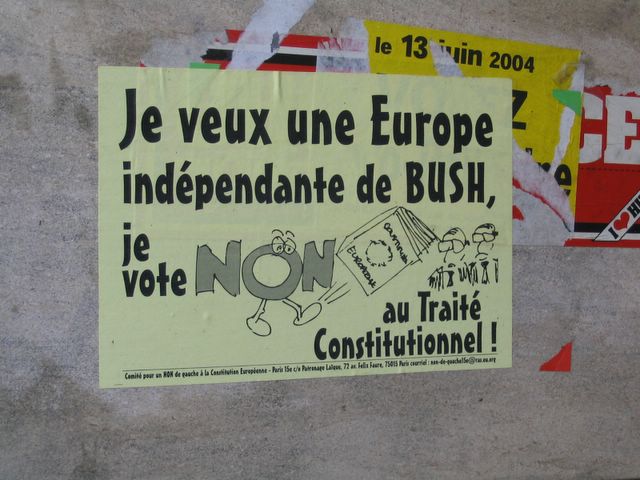
”graffiti”


John Rosenthal of Transatlantic Intelligencer reports that the proposed European Constitution is being attacked as an American Plot ™ and that the opposition is also an American Plot ™!

I tried to read the proposed constitution a while back, there seems to be an awful lot of noise for a constitution with 20 year shelf life. It is way to top heavy of on what should be legislative items. It contains extremely cumbersome procedures, which should keep lawyers in full employment. I hope the Charter of Human Rights is using formalisms common in Europe, which have well defined meanings, I’m not sure what it means in operational terms.

The European Union does need a good constitution. But if this one passes I hope they realize it is their own doing and not an American Plot ™.

Saturday, April 02, 2005

S(*(^%&^%$# Computers

It seems that TM Lutas of Flit TM is having a problem with 404 errors. Check it out.

Friday, April 01, 2005

Such a Night.

We wait for Karol Wojtyla to go home to his Savior. A great man in many ways, but he never forgot that he was called to be a priest; to bring Christ to the world. That he did. Everything else was secondary.

Pray for him in this hour of trial.

Saturday, March 26, 2005

He is Risen ! ! !

Rejoice, heavenly powers! Sing, choirs of angels!
Exult, all creation around God’s throne!
Jesus Christ, our King, is risen!
Sound the trumpet of salvation!

Rejoice, O earth, in shining splendor,
radiant in the brightness of your King!
Christ has conquered! Glory fills you!
Darkness vanishes for ever!

Rejoice, O Mother Church! Exult in glory!
The risen Savior shines upon you!
Let this place resound with joy,
echoing the mighty song of all God’s people!


V. Lift up your hearts.
R. We lift them up to the Lord.
V. Let us give thanks to the Lord our God.
R. It is right to give him thanks and praise.

It is truly right
that with full hearts and minds and voices
we should praise the unseen God, the all-powerful Father,
and his only Son, our Lord Jesus Christ.

For Christ has ransomed us with his blood,
and paid for us the price of Adam’s sin
to our eternal Father!

This is our passover feast,
when Christ, the true Lamb, is slain,
whose blood consecrates the homes of all believers.

This is the night when first you saved our fathers:
you freed the people of Israel from their slavery
and led them dry-shod through the sea.

This is the night when the pillar of fire
destroyed the darkness of sin!

This is the night when Christians everywhere,
washed clean of sin and freed from all defilement,
are restored to grace and grow together in holiness.

This is the night when Jesus Christ
broke the chains of death
and rose triumphant from the grave.

What good would life have been to us,
had Christ not come as our Redeemer?

Father, how wonderful your care for us!
How boundless your merciful love!
To ransom a slave
you gave away your Son.

O happy fault, O necessary sin of Adam,
which gained for us so great a Redeemer!

Most blessed of all nights, chosen by God
to see Christ rising from the dead!
Of this night scripture says:

”The night will be as clear as day:
it will become my light, my joy.”
The power of this holy night
dispels all evil, washes guilt away,
restores lost innocence, brings mourners joy;

It casts out hatred, brings us peace, and humbles earthly pride.
Night truly blessed when heaven is wedded to earth
and man is reconciled with God!

Therefore, heavenly Father, in the joy of this night,
receive our evening sacrifice of praise,
your Church’s solemn offering.

Accept this Easter candle,
a flame divided but undimmed,
a pillar of fire that glows to the honor of God.

Let it mingle with the lights of heaven and continue bravely burning to dispel the darkness of this night!
May the morning Star which never sets find this flame still burning:
Christ, that Morning Star, who came back from the dead,
and shed his peaceful light on all mankind,
your Son who lives and reigns for ever and ever.


Amen.


Exsultet - "The Proclamation of Easter" Easter vigil Mass

Friday, March 25, 2005

Passion


This is Holy Saturday, the saddest day of the Liturgical year; Christ has died, but is not raised. The Apostles, their leader crucified, at least one a traitor, scattered and hiding make their way back to the Upper Room. A tragedy too deep to understand the Savior’s words promising the Resurrection, that will come later, now is the loss of dreams and hope.

Thus it is a good day to comment on Mel Gibson’s Passion of the Christ. Even though there is a Resurrection scene it leaves us emotionally on Holy Saturday.

The story is easy to lose in the violence. Satan is confronting the Messiah, and throws all in his possession to defeat God’s Anointed and bring mankind totally into the void of evil. Violence upon violence is thrown to defeat Jesus by pain, despair, and hopelessness and finally death. The actions of the crowds and soldiers become more and more inchoate and violent. Satan is smirking more and more as the end comes near. Despite this some good remains, Mary Jesus’ mother, and Mary Magdalene, Veronica, Simon the Cyrine and ultimately the Centurion. But the violence goes on. - - - Finally Satan's victory, Jesus dies. - - - But wait - the tear of God washes clean. The temple veil is torn. The curses of the old law have been fulfilled. We see Satan cry in protest as he realizes he is defeated. On the third day, though the Apostles and disciples have yet to realize it, Christ will be Risen.


It is sometime said that the movie is an episode, not a story, and it should include more of the life of Christ, that this one episode does not give the full context. A reasonable comment from those who are not part of the Church. But I think that it is only an episode, the central episode, is how it should be seen. For in the Church the story of Christ is told throughout the year and the story of the Crucifixion is told in Lent and especially on Good Friday. In the Church the rest of the story of Jesus gives context to Good Friday, but even more importantly Good Friday and Easter give context to the rest the story.


The importance of this movie is not in Mr. Gibson’s heroic struggle to get it produced, or in the record box office that rewarded his efforts. The importance is that every year, even when the rest of the world has forgotten about it, in theaters, church basements, on home video, late night cable the Christian Church will be brought back to the Central story of the Christian faith. The rest of year, the story of Jesus no matter how well or poorly told will be presented in the context of the Crucifixion and Resurrection to reaffirm our faith, build our hope, and light the charity of Christ in our hearts.


While the movie described by some as a means of evangelization, I think it is more for the Catacombs, so that no matter how the Church may be scattered, until God in His grace restores her or Jesus comes again, the story of what Jesus did for us will be told with strength and clarity. For

Though Christ has died


On Easter Christ is raised

And Christ will come again!

Thursday, March 24, 2005

Forsaken


And about the ninth hour Jesus cried with a loud voice,
"Eli, Eli, lama sabach-thani?" that is,


My God, my God, why hast thou forsaken me?


Why art thou so far from helping me,
from the words of my groaning?

O my God, I cry by day,
but thou dost not answer;
and by night, but find no rest.

Yet thou art holy, enthroned on the praises of Israel.
In thee our fathers trusted; they trusted,
and thou didst deliver them.

To thee they cried, and were saved;
in thee they trusted,
and were not disappointed.


But I am a worm, and no man; scorned by men,
and despised by the people.
they make mouths at me, they wag their heads;

"He committed his cause to the LORD;
let him deliver him, let him rescue him,
for he delights in him!"

Yet thou art he who took me from the womb;
thou didst keep me safe upon my mother's breasts.

Upon thee was I cast from my birth,
and since my mother bore me thou hast been my God.

Be not far from me,
for trouble is near and there is none to help.

Many bulls encompass me, strong bulls of Bashan surround me;
They open wide their mouths at me,
like a ravening and roaring lion.

I am poured out like water,
and all my bones are out of joint;
my heart is like wax, it is melted within my breast;

My strength is dried up like a potsherd,
and my tongue cleaves to my jaws;
thou dost lay me in the dust of death.

Yea, dogs are round about me;
a company of evildoers encircle me;
they have pierced my hands and feet--

I can count all my bones-- they stare and gloat over me;
they divide my garments among them,
and for my raiment they cast lots.


But thou, O LORD, be not far off!
O thou my help, hasten to my aid!
Deliver my soul from the sword,

My life from the power of the dog!
Save me from the mouth of the lion,
my afflicted soul from the horns of the wild oxen!

I will tell of thy name to my brethren;
in the midst of the congregation I will praise thee:

You who fear the LORD, praise him!
all you sons of Jacob, glorify him,
and stand in awe of him, all you sons of Israel!

For he has not despised or abhorred the affliction of the afflicted;
and he has not hid his face from him, but has heard, when he cried to him.

From thee comes my praise in the great congregation;
my vows I will pay before those who fear him.

The afflicted shall eat and be satisfied;
those who seek him shall praise the LORD!
May your hearts live for ever!

All the ends of the earth shall remember and turn to the LORD;
and all the families of the nations shall worship before him.

For dominion belongs to the LORD,
and he rules over the nations.

Yea, to him shall all the proud of the earth bow down;
before him shall bow all who go down to the dust,
and he who cannot keep himself alive.

Posterity shall serve him;
men shall tell of the Lord
to the coming generation,
and proclaim his deliverance
to a people yet unborn,
that he has wrought it.


Good Friday
Mathew 27;46 and Psalm 22 RSVCE overlapping

Tuesday, March 22, 2005

Abraham Lincoln on Terri Schiavo

In those days, our Declaration of Independence was held sacred by all, and thought to include all; but now, to aid in making the bondage of the negro universal and eternal, it is assailed, and sneered at, and construed, and hawked at, and torn, till, if its framers could rise from their graves, they could not at all recognize it. All the powers of earth seem rapidly combining against him. Mammon is after him; ambition follows, and philosophy follows, and the Theology of the day is fast joining the cry. They have him in his prison house; they have searched his person, and left no prying instrument with him. One after another they have closed the heavy iron doors upon him, and now they have him, as it were, bolted in with a lock of a hundred keys, which can never be unlocked without the concurrent of every key; the keys in the hands of a hundred different men, and they scattered to a hundred different and distant places; and they stand musing as to what invention, in all the dominions of mind and matter, can be produced to make the impossibility of his escape more complete than it is.

Lincoln Douglan debate June 26,1857


Ok, he is talking about the Dred Scott decision. But with minor changes for gender and place to indict the guilty who could tell. At least Dred Scott was not starved to death.


Christopher Blosser does round ups better than any one. Check it out.

Sunday, March 13, 2005

Green is Good!

March 17th is Saint Patty’s day. So, except for beer, if it’s green it has to be good.

But I would think the sight of green meat, green cheese, green bread, and even green beer would have caused the holy monk and bishop to recommend prayer and fasting.

The Breastplate of St Patrick

I bind myself to-day
The strong Name of the Trinity,
By invocation of the same,
The Three in One and One in Three.
I bind this day to me for ever
By pow'r of faith, Christ's Incarnation;
His baptism in Jordan river;
His death on Cross for my salvation;
His brusting from the spicèd tomb;

His riding up the heav'nly way;
His coming at the day of doom;
I bind unto myself today.
I bind unto myself today
The virtues of the star-lit heaven,
The glorious sun's life-giving ray,
The whiteness of the moon at even,
The flashing of the lightning free,
The whirling wind's tempestous shocks,
The stable earth, the deep salt sea,
Around the old etrnal rocks.

Chirst be with me, Christ within me,
Christ behind me, Christ before me,
Christ beside me, Christ to win me,
Christ to comfort and restore me,
Christ beneath me, Christ above me,
Christ in quiet, Christ in danger,
Christ in hearts of all that love me,
Christ in mouth of friend and stranger.

I bind unto myself the Name,
The strong Name of the Trinity;
By invocation of the same,
The Three in One, and One in Three.
Of Whom all nature hath creation:
Eternal Father, Spirit, Word:
Praise to the Lord of my salvation,
Salvation is of Christ the Lord.


Source

Saturday, March 12, 2005

Life in a Medieval Village

Book Review: Life in a Medieval Village
Frances and Joseph Gies
Harper and Row, 1991


The Middle Ages are often mischaracterized with the title of Dark ages. A rather inadequate and inaccurate description for a vast variety of situations, a time when much of the frame work for the modern world was set. To not know something of it is not to have a solid understanding of the modern world.

This book describes daily life in the typical English village of Elton in the late 1200’s to mid-1300’s. The life of the village is reconstructed from contemporary records of the village supplemented by information on similar villages.

Elton was founded prior to 1000 AD, the first records being slightly after that date, on the river
Nene
in the East of England. By the time covered it was a typical “open field” agriculture village and manor. “Open field” agriculture, the norm in Northwestern Europe in this period, typically had three or four large fields practicing crop rotation. Each field was divided in to strips, (easier to plow) some of which the villagers farmed on their own account and common strips in which the owed labor and the produce went to the manor. All land was theoretically the property of the king, the lords being tenants-in-chief (landlords) and the villagers being sub-tenants. In practice each tenant had uncontested ownership of his land as long as the rent was paid. This system required a great amount of cooperation to work but produced one of the more prosperous pre-industrial age economies. On the other hand being pre-industrial age meant that poverty was the norm; they were just less poor than most people in antiquity.

I found internal political/economic structure of village very interesting. We see the beginnings of English Common Law and democracy. The lord allowed virtual autonomy as long as he received his rent. Many holding village office, who were in theory agents of the lord, were in fact elected by the village. The basic rule governing political life was the “custom of the manor” the past or traditional practice. Rights and duties were not normally changeable from what had happened in the past. This tended protect the villagers from arbitrary action by the lord because an arbitrary action would be a change. The lord had an interest in maintaining this system because his rights in respect to the king were also based on past practice. Twice a year the village met in Hallmote (a meeting in the lord’s hall), This was a village meeting, in which set village by laws, elected officials, the board of directors for the village as an economic unit, and the a court. Over time the emphasis on past practice became the Common Law and the Hallmote set the cultural foundation of democracy.

Because the book is intended to be introductory some may find parts a little slow while the authors provide background. I would have liked a little more biography on members of the village, however the nature of the surviving records does not provide enough information to build biographies.

Most areas of village life are covered so you will likely find something you will find especially interesting. This book is written at an introductory level, is interesting, and provides a realistic picture of what it was like to live in a medieval village.


Also see: Voices of Morebath about a village in Devon in a later period

Monday, March 07, 2005

Who Needs a White Sheet

While meandering around the net I found this sentence.

In Mississippi, for example, while African-Americans represent only 37 percent of the population, they account for 73 percent of the state's abortions.

If the KKK was killing that many African American babies there would be an uproar that would break all records.

Article

web site

HT: Orthodoxy Today

Saturday, March 05, 2005

Scripture and Tradition

Frequently the role of Tradition, as understood in the Catholic and Orthodox faiths, is challenged as an authoritative basis for Christian teaching. It is suggested that the rule should be sola scriptura or “the bible is the sole rule of faith.” To understand this issue we need to answer the question “what does the Bible teach about Tradition?”


Before we start we need to eliminate a meaning in English. In English the word "tradition" can have a meaning of "custom". It is traditional to "drive on right side of the road." Certainly every church has customs and as long has they help the presentation of the Gospel they are certainly commendable.


Paul tells us tradition is important:

I commend you because you remember me in everything and maintain the traditions even as I have delivered them to you. 1 Cor 11:2

So then, brethren, stand firm and hold to the traditions which you were taught by us, either by word of mouth or by letter. Thes 2:15

If we are not “standing firm and holding the traditions” we are missing the teaching of scripture. But what would we be missing?


The Greek word in the New Testament for tradition is not only a noun "paradosis" as in English, but also has a verb form "paradidonai" "which is usually translated with terms like "received" or "delivered" (but received and delivered do not always translate "paradidonai"). This keeps a simple check in a search engine from seeing the full meaning of the term. The NASB captures the idea when it sometimes translates tradition as teaching. Tradition is sometimes explained as transmitted or transmission. A tradition is a teaching that is transmitted.

(References: "Dictionary of the Bible" John L. McKenzie S. J., Collier Books. "Dictionary of Biblical Theology", Xavier Leon Dufour S.J., St Paul Books and Media.)

To understand Tradition we should begin with Jesus Christ. Jesus taught There is only one recorded instance of his writing and we don’t know what he wrote (John 8.) The Apostles and disciples taught what Jesus taught and what they had seen with their own eyes. This public Revelation is closed with the death of the Apostle John. The first Christians transmitted this teaching to the next generation. Every generation has faithfully transmitted the teaching to the next.

This transmission of the teaching of Jesus left “footprints” if you will. In every generation (actually starting before the death of the Apostle John 96 AD +-) we have records of what was taught. We can see that the teaching today is the same as the teaching in the 1st Century and at every time in between. If some one is trying to sneak in some novelty it’s difference from what had gone before will standout. If it is not part of the teaching the Church received from the Apostles we should be able to assign name, place, and date to it.

This does not mean the Tradition is a dead explanation. In each place generation the teaching is transmitted so it can be understood by those who receive it. Or since “faith comes by hearing,” the tradition is what is heard. Without changing the teaching of Jesus we come to have a better understanding of the Tradition. This happens especially in response to heresies when it becomes necessary to clarify the true understanding.

The Bible is at the center of the Tradition. The testimony of the Apostles and their associates is recorded in the Bible under the inerrant inspiration of the Holy Sprit. The entirety of the revelation is contained in the explicitly or implicitly in Scripture. This provides the basic facts on which the teaching (Tradition) is based.

Thus we can see that it is not a question of Scripture or Tradition, or even Scripture and Tradition. Scripture is a part of the Tradition. Actually the most important part. Scripture is received and handed on in each generation.


A very good example is 1 Cor 15:3 "For I delivered to you as of first importance what I also received . . . " What is this tradition (teaching) that Paul received and delivered (transmitted)?
"that Christ died for our sins in accordance with the scriptures, that he was buried, that he was raised on the third day in accordance with the scriptures, and that he appeared to Cephas, then to the twelve. Then he appeared to more than five hundred brethren at one time, most of whom are still alive, though some have fallen asleep. Then he appeared to James, then to all the apostles." 1 Cor 15:3-7.

Obviously when some one says they do not recognize tradition, I'm sure they are using excessively overstated hyperbole to make a point; they are not denying this tradition that Paul received and delivered to the Corinthians.

Of course this tradition was not just delivered to the Corinthians, but all the Apostles and disciples delivered the same tradition wherever they preached.

This tradition points out that Jesus rose from the dead. Some modern "experts" are trying to say this means "spiritually rose" or "rose in their hearts" or any thing except He bodily rose. How do we know the scripture means bodily rose? Because that tradition (teaching) that he bodily rose has been received by every generation since then and delivered (transmitted) to the next. In every generation there are commentaries, sermons, hymns, prayers, etc that make it clear this tradition is the true teaching. If we go by "sola scriptura" we would ignore this evidence, line up our verses and they would line up theirs (often the same verses) and say “my opinion of what the text means is better than yours.” We would have no means settling the question except who can yell the loudest, but decibel level is not a proof of truth. If we recognize the authority of Tradition we know that Jesus rose bodily from the dead because this is the constant Tradition (teaching) for 2000 years.


What about "Traditions of Men"?

Jesus, as does Paul, rightly denounces the Pharisees who added their own made up traditions to the Traditions (teachings) of Moses and the Prophets

Jesus: So, for the sake of your tradition, you have made void the word of God Matt 15:6

Paul: See to it that no one makes a prey of you by philosophy and empty deceit, according to human tradition, according to the elemental spirits of the universe, and not according to Christ. Col 2:8

If the modern "Experts" keep misleading long enough, what they are delivering will be received in some places and a "tradition of men" that certainly "makes void the very word of God" will have been created. This is why theological liberals consistently deny or devalue tradition. Tradition makes it impossible to introduce new teachings that deny what was received from the Apostles.

By looking at the whole of Tradition, both scripture and the teaching that has accompanied it, we make sure that we have a sound interpretation and not a personal opinion. After all, having been influenced by the culture of the time and place I was raised, I could easily unintentionally read something in to scripture that the Holy Sprit never intended. But I also look to see what was received in every generation in many different cultures, I can be very confident that I believe what Jesus and the Apostles taught. If I am “standing firm and holding the traditions” (Thes 2:15) that have been held in every generation I am holding the traditions that Paul taught the Corinthians.

An example. The Mormons and Jehovah’s Witnesses have delivered some new traditions (teachings) that in addition to mangling the text were clearly invented by known men at known dates and places. They specifily deny teachings that have been held for 2000 years. Thus these are traditions of men. They are “traditions of men that make void the very word of God.” I think it is interesting that I have never heard a Evangelical point this out. In addition to pointing out the numerous Biblical inconsistencies, I think it is pointing out that they are “traditions of men” would be a convincing argument in their congregations.


Another example. The tradition (teaching) of "Sola Scriptura" was delivered to the church at the Diet of Worms in April 1521 by Friar Martin Luther; about 1400 years after the death of the Apostle John. It has been received and delivered in the Protestant Churches ever since. There is no mention of this tradition before then. "Sola Scripura" is a human tradition, not part of the Traditions Paul delivered to the Thessolians by "word of mouth or by letter", or any of the Apostles delivered to the Church.

If we start with "the Bible is the sole rule of faith" we have to realize that Paul's injunction "So then, brethren, stand firm and hold to the traditions which you were taught by us, either by word of mouth or by letter." (2 Thes 2:15) is a biblical directive to also use Tradition as a rule of faith. The plain words of scripture contradict the basic definition of “sola scriptura”, "the Bible is the sole rule of faith.

One might say that though a tradition “Sola Scriptura” could be considered useful if we do not elevate it to the point of doctrine. An apologetic or teaching device.

Since “Sola Scriptura” teaches us to reject traditions of men, but as a tradition of men itself, it is hopelessly contradictory.


See Sola Scriptura and the Authority of the Chuch

Saturday, February 26, 2005

Do Re Me

One of the puzzling questions in music history is the large number of pieces written around Mannheim in the late 1600’s in which the violin section never plays the note of “C.” This is strange since “C” is in the middle of the scale.

Diligent research by noted music historian Peter Schickele has solved this mystery. It seems the local violinmaker made violins with very elaborate scrolls. As often happens, every violinist of in the area had to use one. However violins with these elaborate scrolls could not play the note of “C”. Thus the local composers wrote music that did not use the note of “C” for the violin section.

This is how the dead “C” scrolls came to be.

Tuesday, February 15, 2005

Environment Modification Update

Global Warming is good

An Event Table not a Timetable

Some are calling for the Administration to publish a timetable for withdrawal from Iraq. The Administration is politely declining to do so.


And so why not?

Any timetable assumes that specific events will happen before any point on the timetable. If the table is published all those who disagree, especially the insurgents, can plan their activities to ensure that the required events cannot happen on time. Even if militarily insignificant every failure to meet the table is a political and psychological defeat. All guerrilla wars are highly influenced by political and psychological factors. Announcing a timetable is a set up for embarrassment at least.


But doesn’t there have to be some sort of basis for planning?

Well yes, but a published timetable is not it. The proper way is to have a table of the desired events. This would underlie a timetable any way, but if the events move forward or backward, or are out of sequence we are not trapped by an artificial artifact.

The officially stated events are along the lines of “as long as it takes for the Iraqi’s to provide their own security and establish a democratic government." In all probability the newly elected Iraqi parliament will have something, if not quite kosher, that looks enough like a democracy that the establishment of a democracy can be announced in late 2005 or 06.


The Army Times is a privately published weekly with this week’s news of the Army. The Army’s “home town” newspaper. It often take the military brass and political leadership to task especially in situations effecting the rights of the ordinary solider. It also serves as the voice of the Army leadership when they want to say something unofficial, such as the frequent complaints on the Secretary of Defense policies, or tell the soldiers something that shouldn’t be announced in a press conference.

This week’s dead tree version carries the headline. “Your ‘Ticket Out of Iraq’ - 15,000 troops whose tours were extended are coming home – How fast can the Iraqi soldiers take over for the rest?” There is a four-page spread on different units and experiences in training Iraqi units. The Iraqi units involved are paired with US units. The message is clear “’get these guys trained!’ so we can come home and stay there.”

So how is this going? The Iraqi troops in the articles were “not up to US Army standards” but getting better. The US trainers had good relationships with the Iraqi’s and were confident in their success. The best overall source is from Global Security here and here. It appears that progress is being made - slowly.

An article (link lost) I read a few days ago many dealt with leader training. The Iraqi’s were interested in taking in all the knowledge they could. The old Iraqi army consisted of a lot of British form and Soviet tactics. They want to learn to fight “like American’s” so they can take over the defense of the their country. The American’s were pointing out every instance in the 1991 and 2003 wars where the Iraqi’s did well to provide the Iraqi’s with confidence. This is not as hard as the press might lead one to believe, the ground force technology difference was not that large, but there were many problems from the way Sadam mismanaged Iraq that prevented the effective use of the Iraqi Army. An unstated conclusion I got from the article is that when the Iraq’s feel they can take over we better be holding a farewell party and getting on the planes. It will be a much better army that “fights like Americans.”

The US Army allots five to six months to train a battalion of initial training graduates into a combat battalion. The Iraqi Army is conducting initial training in units so under optimum conditions it should take 9 to 10 months to train a unit. From the Global security data it looks like significant numbers of Iraqi units will be available starting in late 2005, so even if there is no reduction in the insurgency level the number of US Units should start to decrease.

With the new Constitution in place at about that time the events for major withdrawals should happen in 2006.

But there are only a thousand and one things that can go wrong with trying to attach these events to a firm timetable. The admistration will not annouce any date in advance it can avoid.


Update. 2/22/05

Phil Carter has a link and analysis on training Iraqi irregulars. I agree with Phil this will likely be much more effective.

Interesting quote from Lt. Gen. David Petraeus, who is overseeing the massive U.S. effort to help train and equip Iraqi military units. "To be candid, I would err on the side of fostering initiative. I want to get the hell out of here."

Tuesday, February 08, 2005

Ash Wednesday

In the sweat of thy face
shalt thou eat bread
till thou return to the earth,
out of which thou wast taken:

for dust thou art,
and into dust thou shalt return
.


‘But now, now

– it is the Lord who speaks –

come back to me with all your heart,
fasting, weeping, mourning.’


Let your hearts be broken,
not your garments torn,
turn to the Lord your God again,
for he is all tenderness and compassion,
slow to anger,
rich in graciousness,
and ready to relent.

Who knows if he will not turn again,
will not relent,
will not leave a blessing as he passes,
oblation and libation
for the Lord your God?


Sound the trumpet in Zion!
Order a fast,
proclaim a solemn assembly,
call the people together,
summon the community,
assemble the elders,
gather the children,
even the infants at the breast.
Let the bridegroom leave his bed room
and the bride her alcove.


Between vestibule and altar
let the priests, the ministers of the Lord,
lament.
Let them say,
‘Spare your people, the Lord!

Do not make your heritage a thing of shame,
a by word for the nations.
Why should it be said among the nations,
“Where is their God?”


’Then the Lord,
jealous on behalf of his land,

took pity on his people.


Gen 3:19, Joel 2:12 - 18

Tuesday, February 01, 2005

Never Again and Again and Again

The UN has decided that the ethnic cleansing in the Sudan is not genocide. They do point out that other crimes are being committed. HT: Democratic Peace Blog

Why would they say such a thing?

In 1948 the UN Convention on the Prevention and Punishment of the Crime of Genocide defined genocide “as the intention to destroy, in whole or in part, a national, ethnical, racial or religious group, as such.”

It seems from multiple new sources that what is going on in the Sudan is that the leadership of one group “Arab Moslems” in the Sudan wants to destroy in whole or part the resident population of Darfur, as such: the intentional destruction of a group that is racially black African, ethnically non-Arab, and Christian or followers of a traditional religion.

It seems to me that the facts have a reasonably close relationship to the definition. So why not call it what it is?

The government of Sudan has the power to commit genocide and only outside opposition can stop them. As noted in the article, the responses being discussed are things like “peace keeping” forces that are to small and lightly armed to keep the peace or protect any one including themselves. Bringing the government of the Sudan into the “process” to find a solution and prosecuting individuals who are responsible after the fact. (Why would someone want to be part of process who’s end result will be to put them in jail? They are murderers, not stupid!) But there is nothing about doing anything to stop the crime. So it continues.


I think that part of the reason lies in several changes of perspective in international relations that have been gaining ground in past few years. A movement towards resolving disputes some sort of process similar to how governments handle internal conflicts. This has been a motive in the way the UN operates, the establishment of bodies like the World Trade Organization and the International Criminal Court.


Since the Peace of Westphalia (1648) the use of force between nations was bound up in the idea of sovereign states that would only go to war (at least in theory) over serious violations of agreements or general principles of Internal Law. But no one was required to go to war, and presumably had to satisfy themselves first as to the justice, winability and relative cost of the war.


Internally, in a country when there is an incident, someone calls 911, the police are dispatched, backups are sent if necessary, the SWAT teams may be called out, or even the National Guard called up. After the fact the courts sort out whether it was justified or not.

Therein lies the problem. Genocide has it’s own treaty. Genocide has an extremly poor public image that demands action. The failure to take action in the Rwanda genocide has many people saying that the Military should be deployed at the first sign of Genocide, and let the international courts sort it out afterwards


Why did the UN find that the action in the Sudan is not genocide?

Under the old perspective countries could have said we do not have the means, there is no probability of success, the damage would be greater than the gain and decline to do something. While otherwise calling it what it is and denouncing it.

Under the modern perspective calling it Genocide would be to much like a 911 call. It would have to go to the Security Council who would invoke Article 41ff of the UN Charter and require a military force sent STOP the genocide and the pieces would be picked up later. Like the police dispatcher sending the first squad car the accuracy of the complaint, cost, and likliehood of success would be poor excuses for no action in public opnion or perhaps in court. If it is called Genocide something real has to be done.


Why did the UN find that the action in the Sudan is not genocide? Why, because, under the new perspective, if you do not, or cannot do something you have to lie and say there is not a problem.
There are more than enough uncommited militry forces in the world to stop the genocide if the the political will was there. It is not there.

Amoung the reasons I do not like the new perspective. The old one is a lot more honest.


Related posts

January

Death by Governemnet

April

Rwanda and Darfur Compared


Continuing coverage is at the Coalition for Darfur Blog.

Also R J Rummel’s Democratic Peace blog has provided extensive coverage (Scroll down to Sudan section)

Saturday, January 22, 2005

A First Sign of Hope

Today the news is saying that Palestinian Authority is making a show of force in the Gaza Strip to prevent Hamas and other militants from using the Gaza strip to launch attacks into Israel. This is in conjunction with an offer for a cease fire.


Whatever the original source of the conflict the situation has been revolving around two basic facts.

+ There has been a continuous series of terrorist attacks by different organizations affiliated or claiming affiliation with the Palestinian cause into Israel.

+ The Israelis launch counter attacks to retaliate destroy base areas and enemy units, and to also hold portions of land in the West Bank and Gaza.


Attempts to break this deadlock have run up against two obstacles.

+ The Israelis will not accept any settlement that does not guarantee the end of the attacks into Israel. Israel has a democratically elected government. If an agreement is made and the attacks to not stop, the government will have to either abrogate the agreement due to Palestinian non-compliance or be replaced by one that will. Despite the opinions of a few hot heads Israel will accept the return of the Gaza and West bank territories with rock solid agreement to end the attacks. But there have been enough false starts that most participants in the process are extremely doubtful.

+ The Palestinians Authority cannot accept any agreement that does not include the eventual return of Gaza and the West Bank. The extreme elements in the Palestinian community will attempt to violently overthrow any Palestinian leadership that makes an agreement not to their approval. Additionally many of the extreme elements are not subordinate to the PA and have enough force to maintain this independence. They will simply ignore the agreement.

Any sort of agreement is doomed to failure, the Israelis will insist that any cease-fire must apply to ALL groups supporting the Palestinian cause, some of which will reject it and continue the violence, which the Israelis will see as a Palestinian abrogation and retaliate. The Palestinians will see the Israeli counter attack as an abrogation of the agreement and we are back where we started.

Since the Istraelis will respond favorably to a change of behaivor by the Palestinains and signicant elements of the Palestinian community will not respond favorably to change of behavior by the Israelis the only possible lever to achieve peace is to have a Palestinian Authorty with the ability and political will to control all groups that allege to be working for the Palestinian cause.


The attempt by the PA to actually control the attacks by other organizations is the first step to acquiring the strength that will enable it to make an agreement that will bring an Israeli evacuation and stop the terrorist attacks. A small first step, but the most positive one in years.

Saturday, January 15, 2005

Book Review: Death by Government

Death by Government
R. J. Rummel
Website
Blog
Transaction Publishers (March 1, 1997)


Power tends to corrupt, and absolute power corrupts absolutely
Lord Acton

Power Kills, absolute power kills absolutely. It is advised to get the readers attention in first sentence. Professor Rummel takes that advice to heart in the opening sentence, following on Lord Acton’s famous quote. This book is a census of the people who have been murdered by governments and why. He explains his thesis in the first chapter and the rest of the book is a review of the governmental deka-murders mega-murders, i.e. ten or one millions.

This not limited to genocide. Genocide is the destruction of a nationality, people religious group, most likely by murder, but deportation or dispersal would meet the definition. He uses the terms politocide to describe a government killing for political reasons and invents the term democide, to describe the any situation where a government murders. The 20th century genocidal murders are less than half of all democide. He excludes persons killed by lawful military action or executed for what are commonly considered capital crime. The first function of a government is to protect it citizens/residents from violence, democide is an abomination to the basic purpose of a government.

At this point we should stop and define the political science meaning of “power”. (Rummel assumes that anyone who picks up a book like this would have taken Poly Sci 101 and gives the background minimal treatment) As a neutral term “power” is the ability to influence or cause or do something. The something may be good bad or indifferent. One of odd things one sees is an activist who is unsuccessfully attempting to achieve his goal accusing the opposition of being power hungry. Actually the activist wants the ability (power) to accomplish his goal, he is down right hungry for power. His opposition most likely has enough ability (power) to frustrate the activists campaign without much effort, they are not power hungry they have it. Power should be distinguished from Authority – the right to exercise power, Responsibility - the duty (when where how) to exercise (or not) power, and Accountability – the ability of others to reward or punish for the exercise of power. The last three are part of the structure to control the use of power and prevent abuses.

The main thesis is that Governments or their agents will murder whenever they have absolute power, but when there is a dispersal of power which is accountable checked and balanced (i.e. a “democracy”) this is much less likely to happen. Democracy is in quotes because while he considers a modern liberal democracy preferable he will allow a larger definition. This would include any society where the effective power is distributed among the middle and lower strata of society as well as the top levels. It is the distribution of actual power that counts, some of the deadliest governments this century had externally democratic constitutions but actual power was in the absolute control of a small minority, conversely some of the monarchs of pre-modern times were in theory absolute rulers but in fact had little power without a consensus of at least the middle strata of society. Power can be good in the sense that if even the least members of society have the power to control their their own lives. The essential point is the wide distribution of power. And it is just not a national level, if the agents of even a democracy are in a localized place with absolute power it can be abused. For example an unsupervised night shift in Abu Ghrab prison.

When power is dispersed widely, horizontally and vertically, for a government to accomplish something requires the buy-in of a large percentage of the population. This can be unpopular with those who desire to make radical changes since it can difficult to build a concensus. Where power is concentrated there is little check on those who hold power, they can accomplish something quickly, but if they decide to murder a portion of the population they can’t be stopped. Rummel considers it a virtual certainty that sooner or later this will happen. The slowness and uncertainty of action caused by a wide dispersal of power is preferable to a certain democide when opower is absolute.

At first one is inclined to read the book and say “see my enemies are really bad guys”, but after reading a little more you see your own government or political movement, either in fact or potentially. The deadening recital of demicdes demonstrates that any nation movement or group can turn in to killers if given enough unchecked power. The strongest objections I found to his thesis on a Google search came form people who are part of movements that are trying to aquire enough power to accomplish radical change. Not doubting their good intentions, if Rummel’s theory is correct, when they achieve the power to accomplish their goals they will be added to the list of democide killers. Clearly now the burden of proof is on any group wanting extensive power to prove that they can’t abuse it.

Reviewing Rummels data it seems the 20th Century has had more per capita democide than previous centuries. The modern bureaucratic state can do many things more efficiently than it’s predecessors, including democide.


I would have liked to see him make a distinction between democide by murder and manslaughter. It seems that some of his examples were cases of the government attempting to do something in negligent manner causing massive deaths rather than intentionally killing. The distinction seems important to me to remind governments of the massive unintended secondary and tertiary effects a governmental action can have. This is a reason why the dispersal of power is important, the people who will be effected will be able oppose the action. It seems me that even with this distinction, there was per capitia more murder democide in the 20th Century than in previous centuries.

Rummel points out, that the numbers of killed are estimates. Some of his critics question his methodology. On his website, see above, he has a good explanations of his methodology and why he adopted them. His estimates are higher than the usual figures I have seen. For pre-modern times he accepts the figures in the original sources: data which is often hyperbole rather then mathematical, but the democide happened. One could quibble forever I suppose, but really even if he is 50% over, the value of the book is in the description of the process that produces democide.

I think that a specialist in a given country may have some corrections of the “it was Jones not Smith” category, an occupational hazard of all latitudinal studies, but the value of this study comes from the cross study of many democides so we can see the common process.


This is an important book, a well written book, a must read book, especially for any one interested in politics government military or social justice, but somewhere around 100 million dead I just could not call it a good book.

Wednesday, January 05, 2005

Torture

Wretchard at the Belmont Club has made a post on the use of torture in the GWOT followed by spirited discussion in comments. He points out that there can be intentional constraints on a military force that increase the risk of friendly casualties such as rules of engagement. He counts prohibitions on torture in this category. He is questioning if this restriction is still relevant.


I posted this into his comments section.


In the WOT torture presents an opportunity that would not appear in a
conventional war. In a conventional war one would capture a 100 or so prisoners
and a reasonable percentage will blab without any pressure. There is no point in
torturing the rest for duplicate information. Officers and technitions with
valuable information are not allowed near the front. In the WOT because other
means of information are less usable, a prisoner can be potential source of
major information. Is this a justification for torture?

I would say not.


There are several minor points against the use of torture and I would say a
big one.

Minor

It is not very reliable. The subject is inclined to say what will end the
session, i.e. what they think the interrogator expects to hear. The interrogator
quite possibly does not have the means to sort this out. Since it is what the
interrogator expects to hear they will give it little challenge.

Most often they will talk without torture sooner or later.

It opens our soldiers to retaliation in kind. Even if the
current enemy does not a future one may do so.

It gives a motive to enemy personnel not to surrender increasing our
casualties.

Allowing torture and similar activities tends to break down military
discipline. Having allowed it in one case it is much harder to expect orders not
to do similar things in other cases to be obeyed.

If it becomes public it creates a terrific public affairs problem and
invites outside intervention into the running of our armed forces.

The Major Problem.

If we allow torture then we will sink to the level of Osma bin Laden and
his scum. Even when bin Laden loses (which he will in any case) we will lose
even more!


UPDATE: 072125 January 2005

Wretchard has made a follow up post that provides a better coverage of the issues.

He also has a link that suggests the real problem is much different than reported in the press.

Sunday, January 02, 2005

!!! Happy New Year !!!
Copyright 2004-2012 - All rights reserved. All opnions are mine, except comments or quoted material - who else would want them. Site Meter