Showing posts with label Reviews. Show all posts

Sunday, March 04, 2012

Book Review: Dien Bien Phu: Hell in a Very Small Place

DIEN BIEN PHU, about 1700, 13 March 1954. The the 141st and 219th Regiments of the 312th Viet Minh Division attack the 3d Battalion, 13th Foreign Legion Demi-Brigade at isolated strong point Beatrice. By 0200 it is over. Only a hundred of the 500 legionaries escape, the Viet Minh lose 600 dead and two to three times that wounded. A sign of events to come.


Hell In A Very Small Place The Siege of Dien Bien Phu
Author:  Barnard B Fall
Original edition publishes by Harper and Row, 1967
This Edition by Da Capo Press.

"Hell In a Very Small Place is the classic telling of the siege of Dien Bien Phu and will probably remain the definitive telling. Bernard Fall follows the siege with a "Date Line: Dien Bien Phu" coverage, but also describes the larger strategic and political questions, ties them together, in smooth narrative that very few authors successfully accomplish.


The Viet Minh held the northern stretch of Viet Nam since 1950. Stalemated for years, the French did not have the strength to drive them back to the Chinese border, and the Viet Minh could only slowly increase their strength to take the Red River valley. (Hanoi and Haiphong).

The French had recently granted independence to Laos.  General Navarre, the French Theater commander ordered a "blocking position" at Dien Bien Phu on Route 41 to keep the Viet Minh from moving into Laos. General Cogney, the commander of the Northern comand decided the way to implement that directive was to use Dien Bien Phu as a "mooring point" to launch attacks  against Viet Minh activities in the area. It was never the plan, as often assumed, to set up a strong point to draw the Viet Minh into a trap. General Giap, the Viet Minh commander saw this as an opportunity to inflict a major defeat on the French. His units were moving even before the French occupied Dien Bien Phu.

The French parachuted and captured Dien Bien Phu on November 20 1953. By January the "blocking position" mission was shown to be unrealistic, a full Viet Minh division easily bypassed it and went into Laos. The "mooring point" mission was shut down by increasing Viet Minh pressure.  It was obvious by mid-January that if the French stayed there they would be defending against a major siege. Since the plan had been for a "mooring point" the base had not been constructed to withstand a siege and by January it was physically impossible to import enough material to properly fortify it. The French could have evacuated at that point but do not appear to have considered the possibility. At some point the operation slipped from a side show to the central action defining success or failure for the French in Indochina.

The siege started on March 13. After a month and half of intense combat it was obvious Dien Bien Phu would soon fall. The government in Paris issued orders that it would not surrender, the Americans surrendered at Corregidor, the British at Singapore and the Germans at Stalingrad but the French would not surrender at Dien Bien Phu.   On May 7 the garrison commander, to save his wounded, announced that a unilateral cease fire would take place at 1730, the French destroyed their weapons, the Viet Minh walked in without opposition. There was no formal surrender or white flags.

The heart of the book is the story of an inadequately staffed garrison, in incomplete fortifications, with constant shortages of food, ammunition, medical supplies, and most everything, fighting desparate odds with bravery and skill. Almost every day these worn out soldiers would fight off a an attack then get up and counter attack.  Of the 15,000 in the garrison only 3000 returned to French authority.  Fall treats the soldiers of the Vietminh with equal respect and sympathy.

Some interesting items.

While the larger war was a guerrilla war in the tradition of Mao Tse Tung, in the Viet Minh dominated areas where the battle took place the only guerilla activity was French sympathizing tribes fighting the Viet Minh. The battle was a conventional war siege resembling the trench warfare of WWI or the formal sieges of the 17th and 18th centuries. The massive influx of Viet Minh regulars destroyed the French guerilla forces in this area.

To defend the airfield, key to the position, the French should have defended an area twice as large, with a correspondingly larger garrison, to large to be supplied by the means available. Parachuting supplies kept the the garrison going at a subsistence level. New units were parachuted in to replace losses. 

How to build defenses to withstand modern artillery was published in everyones manuals since WWI. The French only tried to ship in one tenth of the needed engineering materials, the rest of the available cargo capacity was required  for food, ammunition and other essentials; even if all the flights were dedicated to engineering materials there still should not have been enough to complete proper fortifications.

The French force was a multinational and multicultural; French mainland, Foreign Legion, Moroccans, Algerians, other Africans and Vietnamese. The French mainland units were 25 to 50 % Vietnamese. Vietnamese were the largest single group. The Foreign Legion at that time was mainly, eastern European Spanish German and French. This crated a number of problems, rations had to be parachuted in there were several different menus then distibuted to the correct units.. Any thing that looked like favoritism or not recognizing unit characteristics could have ripped moral to pieces.

The Viet Minh were taking a considerable risk. They committed over half of their regular force. They barely had the capacity to supply these five divisions. Their rations were no more generous than the garrisons. Casualties were heavy, but they had virtually no medical infrastructure beyond unit the level. Veteran units at the beginning of the battle filled with barely trained conscripts for the last phases. Morale was often poor. At the end of March Giap realized that the casualties from direct assults were so heavy they would destroy his army. He called a halt to direct assaults and adopted the 18th century tactic of sapping and mining (dig trenches successively closer to the fort.) If things went wrong their war effort would be put back years if not lost. Fortunately for the Viet Minh the French never fully realized the opportunity and did not have ability to take advantage of it.


This books reputation as a classic in it's genre is well deserved.   A superb presentation of a story that will be told for centuries, long after the issues of the war are forgotten.   Fall is both fair and critical at the same time of people and decisions and makes a balanced analysis's of plans and events. There are excellent maps, and appendixes. It is clearly written, and leaves the reader with a good understanding of what happened and why. Readers without much interest or background in the subject might find the very detailed approach challenging. Other than that it is an excellent book and is STRONGLY RECOMMENDED.

Related:
Maothought or Who is Winning
TET 1968: A personal Narrative

Saturday, March 06, 2010

Movie Review: Avatar

It seems you cannot have a blog these days without commenting on James Cameron's epic motion picture Avatar. The special effects are tremendous and worth more than the price of the ticket.


The plot is a pretty straight forward a politically oppressed group on the planet Pandora, “the Na'vi”, defeat the human oppressors, with a boy meets girl sub-theme, and some religious evangelization. A common plot line, a little better executed than most movies with this plot line. The trailer gives a pretty good overview of the plot:


CFV 426 - Avatar/Pocahontas Mashup FINAL VERSION from Randy Szuch on Vimeo.
HT:
Creative Minority Report

---------

In many ways the film is an unintended commentary on how to make a persuasive film.

1.) Cameron has a Pantheist religious worldview and effectively works it into the plot quietly, more by showing than telling. This is done well enough to subtly influence the audience unless they are paying attention.
2.) He also has political message whose impact is reduced by cardboard characters for the bad guys, and a heavy handed approach so that you don’t miss the point. Since the point is so obvious it pretty much immunizes viewers who are not already true belivers.

A lesson for future filmmakers on how to it.

---------------

While a tribe living in one with nature is a nice picture, on earth that is the most grueling from of poverty; never more than a few days food on hand, no certainty of getting more, high infant mortality, low life expectency, no more possessions than can be carried on one’s back, at the mercy of extreme weather, and predators both animal and human. In reality is anything but idyllic.

The updated “natives with righteous indignation and spears defeat machine guns in a frontal assault” plot device is great cinema; but in reality it would just pile up dead bodies for no purpose no matter how righteous the cause. He should have included a “these are professional actors - do not try at home” disclaimer.

The first human effort to work with the Na'vi is personified by Doctor Grace Augustine, the Director of the Avatar program. She presents an updated White Mans Burden approach to dealing with the Navi.

Take up the Human Peoples burden--
Send forth the best ye breed--
Go bind your children to exile
To serve your captives' need;
To wait in heavy harness,
On fluttered folk and wild--
Your new-caught, sullen peoples,
Half-devil and half-child.


But of course the corporate people at home get impatient and send representatives to take a more direct plunder and pillage approach. This sets up the plot. While the soft imperialism of the Avatar program is not as bad as the hard imperialism, I don’t really care for either.

-------------------

The movie also intends to comment on our relations with nature.

From Biology On Line
Ecosystem
Definition
noun, plural: ecosystems
A system that includes all living organisms (biotic factors) in an area as well as its physical environment (abiotic factors) functioning together as a unit.
Supplement
An ecosystem is made up of plants, animals, microorganisms, soil, rocks, minerals, water sources and the local atmosphere interacting with one another
.

Environment
Definition
noun, plural: environments
(1) The external conditions, resources, stimuli etc. with which an organism interacts.
(2) The external surroundings including all of the biotitic and abiotic factors that surround and affect the survival and development of an organism or population.
(3) The totality of the surrounding conditions and elements in an individual.


Pandora is an Ecosystem. The human base is an environmental (external) intrusion that is effecting the ecosystem.
/Satiremode=ON.Poor misunderstood Colonel Miles Quaritch,
he's just trying to protect the environment..
/Satiremode=OFF.

Despite the common usage,
1) Generally one does not protect environments - one protects an ecosystems from undesirable environmental effects.
2) There is no such thing as The Environment, an environment is always relative to it’s ecosystem.
(I know, I know, these are pet peeves and I will never win.)

See the movie for the fantastic special effects, remember everything else is an excuse for the special effects.


The real trailer.

Saturday, January 09, 2010

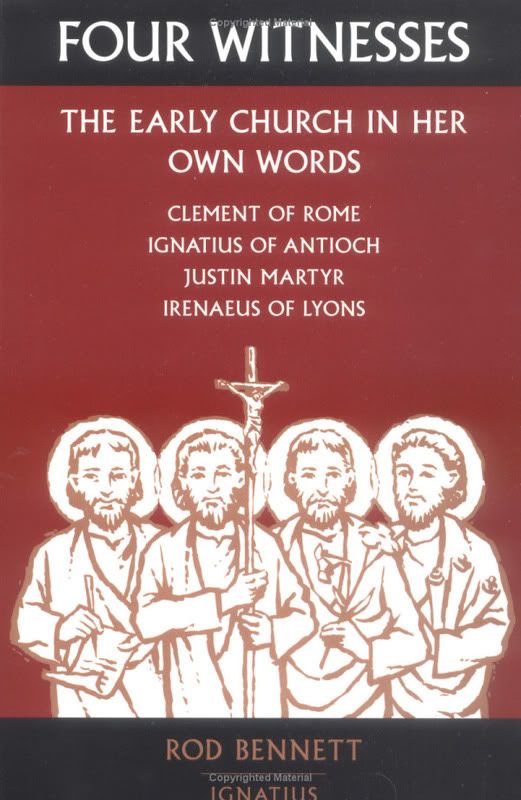
Book Review: The Four Witnesses

“It’s ALL Constantine’s fault!” The primitive Church of the first Christians was lost with the Donation of Constantine in 313 AD. -- So say many critics offering mutually exclusive and often improbable views of the early Church. But just what do we know about the early Church?


The Four WitnessesBook Review: Four Witnesses: The Early Church in Her Own Words

Rod Bennett


Ignatius Press, 2002


“The early Church is no mystery.” Thus Rod Bennett begins his narrative through the first two hundred years of Church History.

The early Church is one of the most assessable parts of ancient history and Roman society. Recorded in the Anti and Post Nicene Fathers and a number of other works which are on line and even before the internet, the essential writings were available in reasonably priced books.

Bennet follows the story with the lives and writings of Four Witnesses, Clement of Rome, Ignatius 0f Antioch, Justin Martyr, and Irenaus of of Lyon. woven into a easy to follow narrative. He tells the story of the Church discovering, once the Apostles had died; the heritage they left, how the Church was to exist as hostile society, worship, and deal with challenges inside and out. All four were in churches that faced major persecutions. Two of his witnesses were martyred and the other two may have been. The threat of a persecution was always with them. But it is also of people who grew in the love and service of the Lord. The issues they faced were remarkably similar to today’s issues as are proposed solutions.


When I first read the Fathers of the Church I found them reinforcing what I had learned about the Catholic faith from more modern sources. Bennet had a rather different experience. As an Evangelical he had been raised with a different understanding of Church History but also with the Evangical idea that the early Church should be the model for the modern Church. When he discovered the Church fathers he dug in to them so he could learn about the early Church and Jesus from those who were much closer to him in time. As he read he discovered that the Early Church was not modern Evangelicalism it was Catholic. Since his Witnesses were writing a hundred to two hundred years before Constantine the “blame it on Constantine” line did not work. His story of working through this is a compelling story in itself.

This book is intended for those just learning about the early Church, but can hold the interest of those well read on the subject. He provides a good introduction of the Early Church, it’s faith, and also a glimpse of the Roman Empire not normally seen in the usual Roman histories. And no Constantine.


Also:
Frank Capra: It‘s a Wonderful Life Bennett’s review of the work of Frank Capra.

Related:
Perpetua and Felicity - Martyrs
They were martyred in Carthage shortly after this period

Monday, September 28, 2009

What Kind of Reader Are You?

What Kind of Reader Are You?
Your Result: Dedicated Reader

You are always trying to find the time to get back to your book. You are convinced that the world would be a much better place if only everyone read more.

Obsessive-Compulsive Bookworm
Book Snob
Literate Good Citizen
Fad Reader
Non-Reader
What Kind of Reader Are You?
Quiz Created on GoToQuiz


I must be slowing down.

HT: Roger A Payne’s Blog

Monday, September 21, 2009

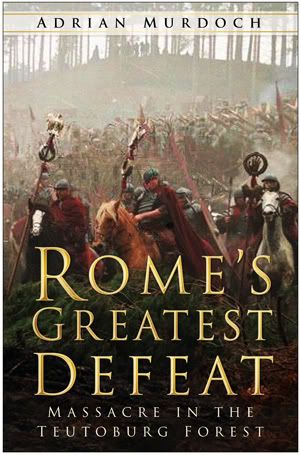
Book Review: Rome's Greatest Defeat

Two thousand years ago this month the Roman Army in Lower Germany, three legions strong with auxiliaries, was was wiped out, almost to a man. The battle of the Teutoburg Forest is one of Rome’s largest and most famous defeats. Until recently very little was known about the battle, even it’s exact location, except for a few second hand reports from Roman authors. Recently a number of archeological discoveries have shed light on this battle.


Rome’s Greatest Defeat: Massacre in the Teutoburg Forest
Adrian Murdoch
Sutton Publishing, 2006

Murdoch's Bread and Circuses Blog
The Blog's Teutoburg Posts

Imperium Konflict Mythos Official 2000th Anniversary site.
Kalkriese Museum


Adrian Murdoch describes the tangle of political, cultural and military affairs that led to this battle and the consequences. The account of the battle is just a chapter but with a judicious reading of the ancient sources and modern research he presents a very common sense account of the events leading up to the battle , the battle, and it‘s consequences.

Lower Germany was in the process of being integrated into the Empire. Murdoch describes this process, involving a forced change in the culture politics and economy of the province. It was always complicated with winners and losers at many levels of socity and sometimes resulting in a revolt, usually defeated with much bloodshed. He tells the story of Sextus Quinctilius Varus a proven governor, able administrator, and competent general who was apparently under orders to speed up the process; and Arminius a German noble, an officer in the Roman army, and secretly a leader of the anti-Roman faction. Arminius managed to set up an alliance of several tribes, despite opposition in his own and the other tribes, while convincing Varus of his loyalty and preparing a trap for the Roman Army. There was a report of a revolt and Varus and the Army set off to deal with it and marched into the carefully laid trap, for three days they fight to escape and are finally annihilated at the recently discovered battle field at Kalkriese. The defeat rocks the Roman world, and the resulting Roman punitive expedition wrecks the hostile tribes for generations. The Romans make no effort reestablish a permanent presence on the east side of the Rhine. The impact of the failure to Romanize German culture has been debated for centuries. Much later Arminius becomes a hero in the development of German nationalism. Arminius gets the rare distinction of being a general who defeated the Romans: but is not killed by Rome or dies in their captivity.

Defeated generals are always easy targets for blame, Murdoch shows that despite the accusations of incompetence heaped on Varus, he was in fact a competent governor and general, selected for both ability and loyalty the Emperor. He had extensive experience as governor of the tumultus province of Syria. Many of the criticisms of his action are based on 20/20 hindsight but his actions were quite reasonable in the circumstances.

Arminius had learned soldiering from the Romans, but a was also master of the German tribal politics. There were many in the tribes, including members of his own family, who favored cooperation with Romans, ether because they saw an advantage or it was the lesser of two evils. Arminius managed to convince enough of the leadership in the tribes to join him. Since Arminius was a central contact for Roman contact with the Germans he controlled much of the information going to Varus. Murdoch thinks that Varus dismissed the reports that got to him as attempts to draw him into the internal politics of the tribes, which he declined.

Murdoch’s encyclopedic knowledge of the classical world, his easy writing style and common sense analysis provide a clear explanation of the events that is assessable al l readers. This is by far the best of the recent books on this battle that have been published in English. Strongly Recommended.

See Also

Book Review: The Battle That Stopped Rome by Peter Wells
Book Review: Quest for The Lost Legions by Tony Benn

The Advance Guard Fiction

Related
Book Review: Eagle in the Snow
Book Review: The Fall of the Roman Empire


Analysis and opinion.

What happened, this is my assessment.


Possible Route of Roamn Army 9 AD Teutoburg Forest

One thing is certain is that Varus did not get his route from Google Maps, but it is a best case close approximation and gives an idea of what was involved. [See comment from Delta V] He was moving to put down a revolt was in what is now the northern Netherlands or extreme northwest Germany. It is sixty kilometers from Minden to Kalkriese and another ten to Bramsche. 100 kilometers more to the legionary fortress at Haltern or 150 kilometers to the base at Xanten on the Rhine, He would have been expecting to march for about six hours 20 to 24 kilomters a day with column of about 12,000 solidiers, at least the same number of camp followers and 5000 horses or oxen. Quite possibly the advance guard would be marking the evenings camp as the rear guard was exiting last nights camp. Given the large amount of equipment they carried they would have at most five days of food.

This is the shortest route with the least hills, we forget how important that was when everything moved by sore muscles and aching backs. The route is mostly open farmland making it possible for the Army to get at least some of it’s food locally. Tactically it is reasonable ground, with only one real choke point, the narrows at Kalkriese. The other possible routes were longer, had less farm land and more obstacles. I think that the first leg of his march was to the area of modern Bramcshe, where the army would have to spend a day on river crossing. From there he could send his excess baggage back to Haltern or Xanten with a small escort and the tactical part of the Army would move to suppress the revolt. He would have made a prior announcement that he will be buying food at Bramcshe for the next leg of the march. All this assumes he believed he was marching through friendly territory.

The tactical system of the Roman army was a combination of heavy and light infantry supported by cavalry. The legion provided the heavy infantry. The legion can be compared to a steam roller. Nothing could stand in front of it. But it was slow and awkward to move, subject to flank attacks and required an enemy who was willing or forced to stand in front of it. Rough terrain could break it’s formation reducing it’s effectiveness. If the enemy had fortifications the legions engineers would overcome them with time. The other half of the team was the light infantry. This was either Roman auxiliary cohorts or forces provided by allies. They would scout, protect the flanks, clear enemy scouts, and with luck push the enemy under the steam roller. The light infantry would guard the legions march into hostile territory where the legions would attack a political, cultural or economic location that the enemy must defend, i.e. stand in front of the "steam roller" and hope to win. The important thing is that the legions of this period could not act alone they needed their light infantry support. The light infantry could operate alone but they would seldom be able to defeat an enemy unless they out numbered them or they had some unusual advantage. It was the team effort that make the Roman armies formidable. A common statistic in Roman history is the light and heavy forces were approximately equal strength. Varus’s Army did not have enough auxiliaries to provide the light infantry part of the team. The other auxiliary cohorts were garrisoning forts throughout the province. Varus was depending on his German allies to provide the light infantry.


In August Varus received word of the revolt. He started his preparations and called back his scattered garrisons to Minden, which is a good concentration point and possibly his headquarters. I think, since the route was known he had engineers out improving the road and had his German allies secure the route and occupy critical points such as the narrows at Kalkriese (with fortifications?). The word was sent out where he would be buying food along the route. The Allied tribes were called to come join him, either at Minden or Bramsche. The warnings he had received probably seemed to be part of the background noise that happens in any occupied province, but nothing so significant as to arouse suspicion, or make him distrust Arminius.

The Army moved out. I would think they would have made twenty to twenty four kilometers, and built a camp. The next day the advance guard had moved another twenty to twenty four kilometers and was at or close to it’s intended camp for the night when the attacks started. The front of the Army started to set up a camp and the rest closed in on it. There would have been hundreds of little attacks, each not causing much damage but the total would add up. The ground was still open enough that the Romans could move off the road and clear flanks. The baggage trains were probably hurt worse than the troops. This would be a nightmare for Varus and the senior commanders, the Army was spread out along the road there was little they could do to influence the battle. It was a centurions and soldiers battle, if the army was not well disciplined and trained it might not have survived the first day.

In the camp they got ready for the next day. The Army was in trouble but it was not defeated. Wagons and excess baggage were burned. This shortened the length of the column and make it eaiser to bypass obstacles. To make matters worse the fierce autumn German thunder storms started soaking every thing and making the roads much less usable. The Army rested as much as it could, reorganized and came out fighting. They moved a lot slower because they were in a tactical formtion partly off the road, the Germans destroyed advance work of the engineers, the rain, and fighting off constant attacks. By nightfall they would have been lucky to have advanced ten kilometers. they established a new but a vary hasty and improvised camp. The Army knew it was not going to get home. Varus and his top aides committed suicide, the cavalry tried to ride out, some tried to surrender. In the morning the Army moved out in a forlorn hope on broken ground and came to the ambush at Kalkriese. Most of the army perished here. Only a handful got back to Roman territory.


Once Arminius united the tribes and attacked the Army, the Army was lost, every thing else was details. The Army was, at best, seven to ten days march on half rations from nearest fort. The closest possible relief force was at Mainz a months march away. The tactical system was broken, without light infantry the legions would be would be worn down in a series of small actions. They were north of the Wiehengebrige ridge and their bases were on the south side. Forcing any of the gaps in the ridge would require light infantry. A wall had been constructed at Kalkrese, the engineers could defeat it with time, but a retreating army on half rations does not have time. A Gaius Julius Caesar might have brought that army home, but Sextus Quinctilius Varus was simply a competent general in a situation where genius might not have been enough.

The defeat was more political than military. The credit is Arminius’s as a political leader for uniting tribes and the defeat is Varus’s as governor for failing to prevent it.


Note: The exact size of the Army and how much road space it took, can’t be determined from the existing data. I made a number of assumptions, but small changes make big changes in the result. The Roman legions were probably between 2000 and 4000 men present for duty, I think closer to 3000. The auxiliaries were probably another 3000 men. The number of camp followers was usual about the same as the number of soldiers. They other big factor is how wide was the road. I am assuming it was wide enough to march four abreast, which would also be wide enough for a wagon. There would be an interval (size?) between units, necessary to keep the army from bunching up an spreading out on hills and turns. While the Romans were masters at it, moving an Army this size was difficult to manage under the best of circumstances.
For those who want to crunch their own numbers.

Field Manual 21-18 - Procedures and Techniques of Foot Marches

The March

Saturday, July 25, 2009

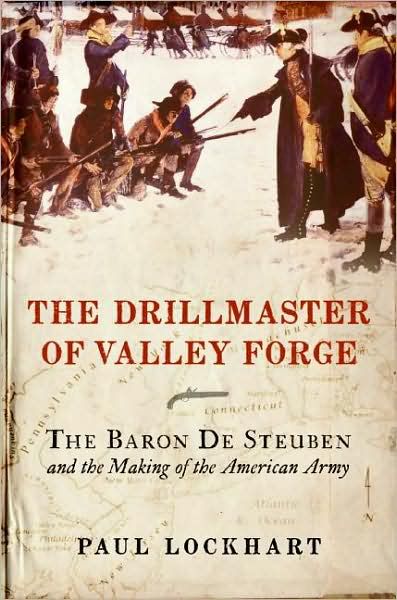
Book Review: The Drillmaster of Valley Forge

In June 1778 George Washington’s Continental Army tried to destroy the rear of the British Army near Monmouth NJ. An indecisive battle of little note except for the first time Washington’s Continentals met British Regulars; held their own and gave as good as they got. What caused the transition of the Continentals from semi-disciplined amateurs to a trained army able to fight on the regular’s terms?


Drillmaster


The Drillmaster of Valley Forge: The Baron de Steuben and the Making of the American Army

Paul Douglas Lockhart

Publisher: Collins (September 9, 2008)


Frederich Wilhelm Ludolf Gerard Agustin von Steuben was born on September 30th 1730, among the godfathers for whom he was named was King Frederich William I of Prussia, with his permission. His father was an engineer in the Prussian Army a holder of the Pour le Merit a soldier of great reputation and no wealth. Steuben joined the Prussian army at fourteen and followed the usual steps of a regimental officers career for ten years until the Seven Years War. He distinguished himself as a regimental officer, in an elite light infantry battalion, and then in a number of staff positions from brigade to the Army Staff. Near the end of the war Frederick the Great selected him for advanced training. But at the end of the war, despite being known as an up and coming officer he was discharged for reasons that are not entirely clear. He was employed as the Court Chamberlain of the minor German State of Hohenzollern-Hechingen until his efforts to find military employment let him the American side in the Revolution. While Chamberlain he was awarded the title the Frieheer, loosely equivalent to a British knighthood, but translated into French as Baron. Thus he was Baron de Steuben. But not “Baron von Steuben” which would represent a very different position.

Benjamin Franklin got him an appointment to the Continental Army. Washington appointed de Steuben as Inspector General with the rank of Major General. At that time this position was more similar to a G-3, operations, than the ombudsman and administrative inspector of the modern army. The biggest problem at the time was the Army had no consistent method of training drill or discipline. Each regiment followed the drill of the commanders drill book (there were several in publication) and this was done to varying levels of commitment and success. His solution was to form a model company to teach a basic drill then send it’s members back to their units to act as instructors. He established a through inspection program to see that it was done. He cut quite a figure, riding through camp with the pomp of a Prussian General and major nobility, on the drill field, personally demonstrating and correcting, swearing like a trooper, and always, when inspecting putting the welfare of the soldiers on the same basis as drill. In three months, even after the devastating winter of 1777/78 the Continentals were a disciplined and trained army with confidence in there own abilities.

That spring of 1778 the British retreated from Philadelphia to New York by land, Washington set off to intercept him, knowing he could not defeat the larger force he planned to cut off and defeat the rear of the British column. The lead of the attack was entrusted (by seniority and politics) to General Horatio Gates whose poor planning and execution caused the attack to stall then he ordered the army to retreat. However with there new found confidence and training individual regiments held together as disciplined units, they knew they hadn’t been defeated and wanted to fight. Washington came up, rallied the Army and turned the retreat into a defense and then counter attacked. Something the Continental Army could not have done a few months earlier. De Steuben commanded the reconnaissance forces for the Army and provided Washington with excellent intelligence on where the British were and what they were doing. He also played a key role in turning the retreat around.

After this he continued to serve as Inspector General, made a number of reforms, and served as a temporary field commander when Washington needed someone with special abilities. An outsider with no alliance to the many factions he could accomplish this where other officers would have had their efforts lost to politics. But this also denied him an assignment to a major command. He wrote the Army’s first Drill Manual which remained in effect until 1812, while the tactical parts are long outdated, the section on leadership is still good guidance.

In 1780 de Steuben was appointed second in command for Nathaniel Green’s campaign to recapture the southern colonies. Green left de Steuben in Virginia to organize a base, forward supplies and recruits, and then follow Green. However, the British landed an army in Virginia, under Benedict Arnold, giving him the responsibility to defend Virginia with the forces at hand. Not quite the way de Steuben wanted it, he had his major command. This campaign is often cited as criticism of his actual battlefield generalship as opposed to his drill field leadership. Lockhart makes a good case that de Steuben did as well as anybody could in the circumstances and better than most, though his lack of tact in dealing with local politicians hurt his efforts. With an army of changing and occasional militia, a battalion of newly recruited continentals, hardly better trained than the militia, never totaling more than a fraction of the enemy, he prevented the British from capturing Virginia or using it to support the Southern Campaign. Notably, he fought two successful delaying actions against larger forces, saving his army and critical war stocks.


There are many controversies about the veracity of De Steuben’s credentials. Lockhart establishes the he was in fact a member of the minor nobility at birth and entitled to use von Steuben. This brought him no land or income but gave him the social status to be commissioned in the Prussian Army. Baron de Steuben certainly did not discourage people from thinking “baron” was the equivalent of a British Barony. Foreign officers had by this time, a poor reputation in the Continental Congress. Benjamin Franklin and Silas Dean, the American representatives in Paris, decided that de Steuben with experience and abilities beyond his status a former captain in the Prussian Army, needed to have his credentials enhanced, reporting him as owner of massive estates and a former Lieutenant General in the Prussian Army. This was apparently not his doing, though he went along with it, and quietly let on after he was accepted as a Major General in the American army that this was inflated. Also de Steuben was prone to be ambiguous inexact and expansive in personal correspondence leaving the impression of much greater position than he had.

De Stueben's personal life was a shambles, he could not manage his personal finances, popular but with no intimate friends, charming or tactless, loyal to a fault but never letting go of a grudge. His reputation is clouded by rumors of all sorts, which if true, no primary evidence survives. As a soldier brilliant, a failure at every thing else. But it was the mess of his personal life that led him to serve in the American cause, a man with badly needed talents and abilities. Truly he helped make the American Army.


A good book for readers of all levels of interest. The authors explanations of the how and why of de Steuben’s reforms is good background for any reading on 18th Century warfare. Interesting illustrations and adequate small scale maps, some large scale maps of individual battles would be nice. Strongly Recommended.


Related: The Year of the Hangman, George Washington’s Campaign Against the Iroquois

Sunday, July 05, 2009

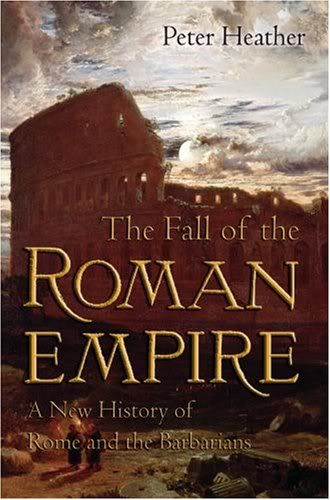
Book Review: The Fall of the Roman Empire

Why did the Western Roman Empire fall? The rise of Christianity, corruption, the decadence of the ruling classes, over taxation, changes in military policy? Or was it simply the Barbarian invasions?


The Fall of Rome: A New History of Rome and the Barbarians The Fall of the Roman Empire: A New History of Rome and the Barbarians


Peter Heather
Oxford University Press, 2007


Peter Heather attributes the primary cause to exogenous shock caused by the barbarian migrations into the Empire in the late fourth and early fifth centuries. If these shocks had occurred earlier the Empire would have fallen and if they had not come the Empire would have lasted several more centuries. The Empire was a stable entity, with internal problems, as has any political entity, but they were within the outer limits of what it could manage and still function. The rise of the Persian Empire in the East in the third century had created a superpower challenge that required heavily reinforcing the eastern borders. This was successfully done, but doing so greatly stretched the resources of the Empire so that it had little surplus resources to handle a new crisis. The migration and invasion of the barbarians provided that crisis.


Heather sees the Empire as a symbiotic relation of several components:

The Landowners were Roman citizens who had a common education and culture that provided a homogeneous “Romanness”. They, more than the residents of the City, were the Romans. Whether they were of the old Roman families or provincials from cities that had obtained Latin rights they spoke and wrote common “Classical Latin”, shared common values provided the civil and military officers that staffed the empire, and provided leadership at the middle levels of society.

The Central Government taxed trade and land and used the revenues to pay and equip the Army. The Army protected trade and agricultural activities against outside threats and internal disorder. With an assurance of safety against outside threat and internal disorder agricultural activities and trade could produce enough wealth to provide higher standards of living and pay the taxes to support the Army. While the system primarily benefited the landowners there it must have also produced enough safety and income to be preferable to the alternative for most of the population.

The Army saw (as did most every one else) it’s first job was to defend the Empire against the Persia. During the fourth century 20 to 25 percent of the Army was directly deployed opposite Persia. The rest of the Army was either in border garrisons defending the long frontier or in the field armies that constituted a reserve to reinforce against attacks on the border or counter attack. While the total army was probably about 600,000 men the maximum field army that was available west of Constantinople to deal with the invasion on the Rhine-Danube line was about 80,000 spread among several field armies belonging to both parts of the empire. When matched against the nations migrating with their full strength, as opposed to raiding and border skirmishes, the numbers available to both sides were similar, and until reinforcements could arrive, could favor the invaders.

The Exogenous Shock.

The Germanic Tribes in the 1st Centuries BC and AD that the Romans came in contact with were economically hunters and “slash and burn” farmers. Every ten or twenty years a village would exhaust its fields and move. Heather thinks that the real reason for the Romans stopped at the Rhine was not the defeat of Varus in 9 AD at Tueutonburger Wald but that the region could not produce enough taxes to support the Army. Though not conquered the Germans learned from the Romans. They developed a stable agriculture, which supported a much larger population than slash and burn farming, and permitted the development of trade and manufacturing. This improved economy allowed them to field larger and better equipped armies. The service of many Germans in the Army had taught them the military skills to use the larger force. In the Late 4th Century the Huns started to invade the homelands of these nations forcing them to migrate and the only place they could go was into the Empire.

The Huns were a warlike tribe of nomads that came off the steppes and invaded the area of the German tribes forcing them to migrate. The Hunic economy and political structure did not allow them to settle in one location; they kept attacking westward forcing more dislocations until they were fighting the Romans themselves, though eventually defeated by the Romans the damage had been done.

The Migrations of the Germanic tribes into the Empire to escape the Huns in the 376 and 402-10 started the unraveling of the relationships that held the Empire together. War and invasion would put farms out of production temporarily or permanently depriving the Government of the taxes to support the Army. This made it harder for a reduced/weakened Army to recover lost lands or protect those that were left. Which would result in more land going out of production. The loss of this protection made it expedient for landowners to support the invaders to keep their lands rather than support the central government. Slowly over about 100 years the Western Empire unraveled.


The result

A controversy in recent years asks was The Fall really a fall or just a change in the political arrangements with life going on pretty much as before. Some point out that many institutions survived, there was a definite Roman characteristic in the successor states and there were people who called themselves Romans for a long time after the fall. Heather argues, I think successfully, that while it was a process over time with important survivals, The Fall was really a fall and a hard fall. While for most any one other than poor Romulus Augustus, the last emperor, who was removed on September 4, 476, September Fifth was not much different than September Third; but the Western Europe of 576 was vastly different from the Western Europe of 376 when the migrations started. While some people must have come out ahead the vast majority of the reduced population was much impoverished with far less physical and economic security.


Analysis

This is a well written book explains the story of the Fall of The Roman Empire in a way that treats both the available data and the persons involved with respect and reaches conclusions without forcing the data. While he gives a varied review of the different explanations for the Fall of Rome many support his explanation as part of the reason the Empire was overstretched. Unlike most commentators he believes the economy was able to support the Empire so long as it did not have to deal with extraordinary events. He tells the story of people with ordinary ability trying to control and reverse events that were to large for them to control. One thing I liked was his account ties together the different parts of my limited knowledge of the Roman Empire into a coherent whole.

It will certainly not end the debate over the causes of the Fall of Rome but it is a major contribution to the discussion, whether future historians agree with him or not this is an explanation that cannot be ignored. The book has good pictures and maps that support the text. Strongly recommended.


Related: Eagle in the Snow by Wallace Breem. Review of a fictional account of the Barbarian invasion across the Rhine in 406/407

Topic: All my Rome posts

Tuesday, February 03, 2009

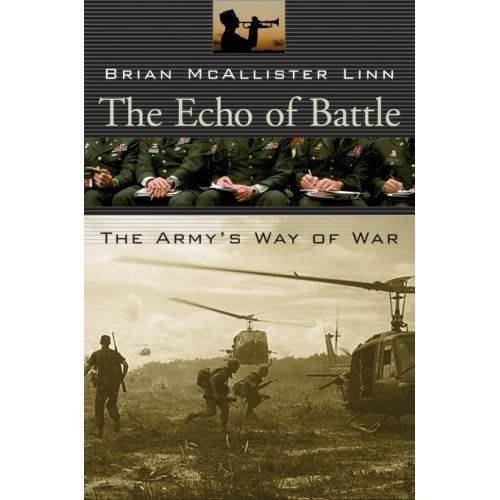
Book Review: The Echo of Battle

“Armies always prepare to fight the last war.” The Army is accused of preparing for the Cold War/World War III and then fighting an insurgency in Iraq. The Army is now as prepared, as it ever will be, to fight the war in Iraq. In two years (or hopefully less) this will be the last war. The Army is again ready to fight the last war –Iraq. But in reality we could end up in any of several types of war, and as the 3d Infantry Division found in Baghdad, the type can change overnight. Since the M-2 Crystal Ball is hopelessly stuck in development, how does the US Army determine what the next war will be like, and prepare for it?

Echo of BattleBook Review: The Echo of Battle: The Army's Way of War
Brian McAllister Linn
Harvard University Press


Brian McAllister Linn’s latest book looks at the question of how the Army thinks about preparing for the next war. He identifies three intellectual traditions in the Army with very different ideas on the nature of war, and what will be needed, and how to prepare for it. During peacetime when they look at past wars they see different things that contributed to success or failure, and advocate different virtues approaches and solutions. The Army’s preparations for the next war are based on the interplay of these traditions. All of them have made major contributions and all of them have been the source of significant problems. Officers of each tradition have been excellent commanders and notable failures. When each tradition listens to the lessons past wars and draws conclusions it is influenced by it’s values, thus it hears only The Echo of Battle it expects.

These different traditions have dominated at different times. These are tendencies; individual officers may have ideas that are from two or even all three schools. No tradition has ever been so suppressed that in need it could not reassert itself. Each will propose it’s own explanations for success and failure. The success or (more often) failure of these traditions to interact with each other and larger events provide the intellectual framework how the Army prepares to fight the next war.


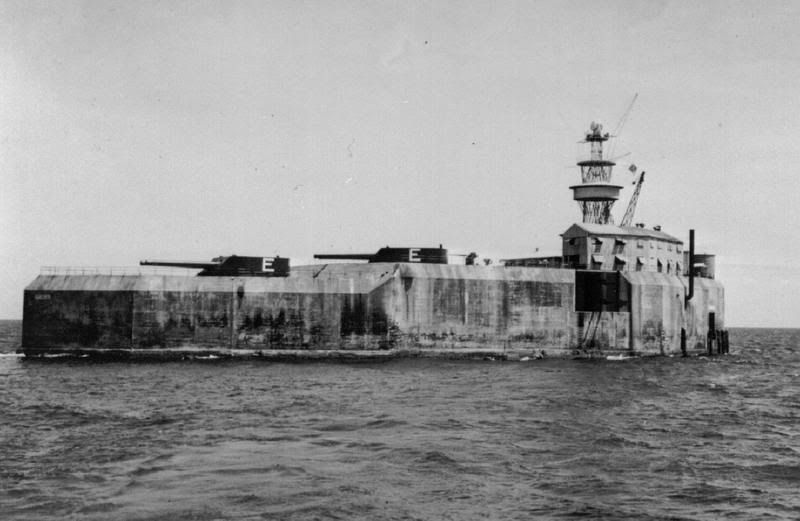
Guardian - Fort Drum, Mainila Bay PIThe Guardian sees war as in exercise of Science.
War can be reduced to a Science and correct action is deduced. Basically an engineering project, apply the right formulas and win. Victories are explained as the result of good doctrine and equipment, a defeat means there was some defect the doctrine or equipment, a reason for more study of the science of war in the future. The political assumptions of the Guardians are that the world is a cruel and brutal place and war could be imposed on us with no notice. It is usually associated with the assumption that US military policy is defensive, offensive action at the national level is not taken except in response to other countries actions or to defend vital national interests. The 19th century Coast Defenses are the classic example of their influance. Small wars are side shows which divert resources. The purpose of the Army is to deter war more than fight a war. This assumes very little diplomatic or political involvement; some one attacks and we defeat them and let the diplomats sort it out later.

At it’s best it places good equipment in the hands of the troops with good tactical/operational doctrine to use it. At it’s worst, when war is not deterred, it does not have a National Military Strategy to implement the doctrine and equipment it provides.


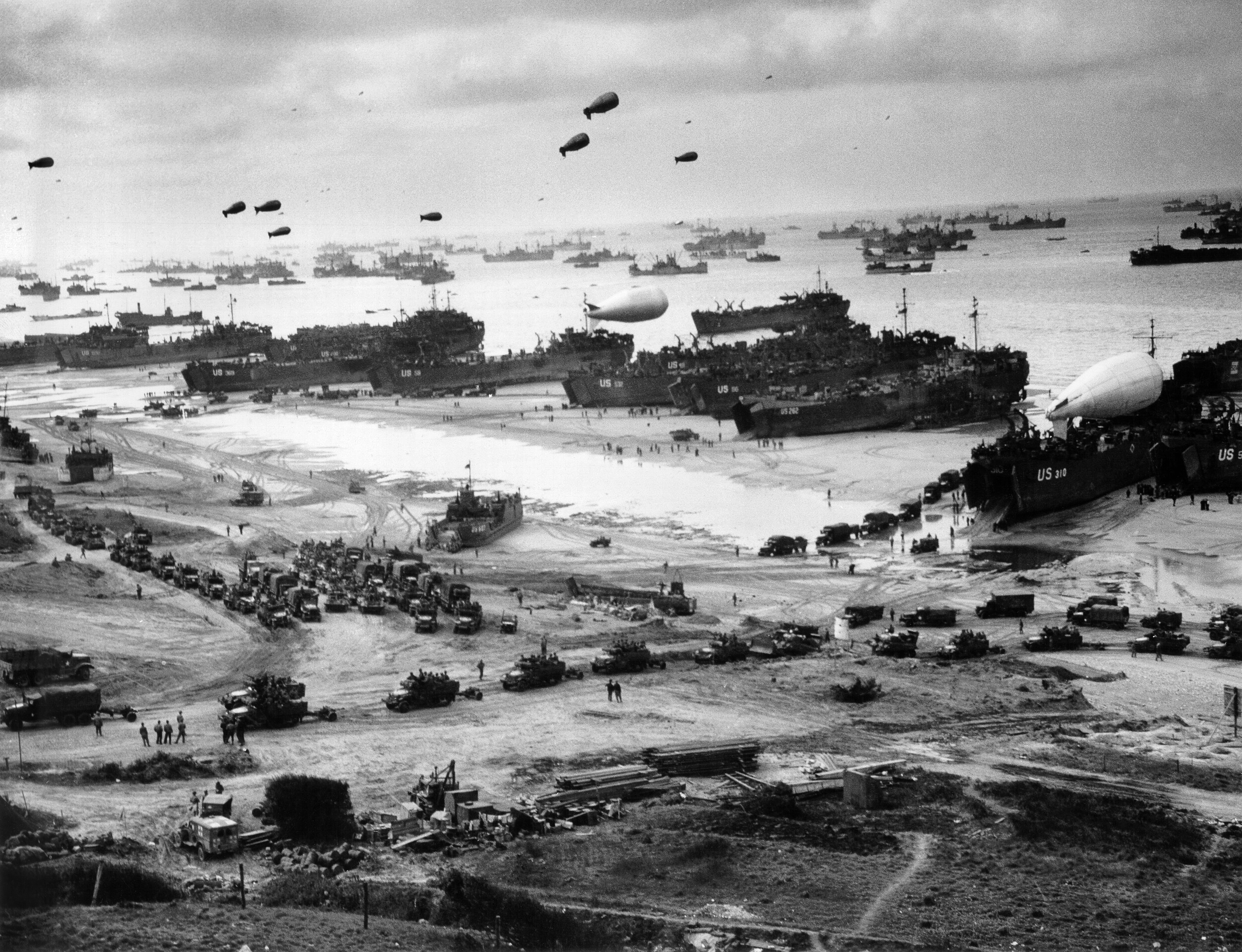
Managers - Normandy LandingsThe Manager sees war as an activity to be Managed.

It sees modern war as the mobilization of societies fielding large armies to win a war for national survival, or a crusade for some great goal. War requires careful planning for the organization and mobilization of society to create a mass army. The use of standardized programs and equipment is the only way to manage these large forces. It tends to de-emphasize human factors. WWII, which was a manager’s war in many respects, is the war where American soldiers started calling themselves GI’s (Government Issue.) The invasion of Northwest Europe in WWII is it's greatest sucess. When a war occurs it dominates all aspects of society. During a war political activity is subordinated to the great goal. Again this assumes very little political or diplomatic involvement and then at the service of the war effort, after the victory the diplomats will work out (dictate) the peace.

At it’s best it enables the deployment of large forces to fight major enemies and ensures that the troops in the field are the best-supplied army in the world. At it’s worst it promotes bureaucratic stagnation, and overlooks the fighting of small wars.


Hero's - Battle of ChippewaThe Hero sees war as a Human endeavor.

People fight wars, thus the traditional military virtues of courage, character, and loyalty are essential to any successful operation. While the Guardians and Managers are engineering and managing for the next war, the Heroes were the line soldiers who fought Indians, pacified the Philippines, chased Poncho Villa, and made the surge in Baghdad. They fought the in front line of all the major wars. They know that a war cannot be considered won if you just win the battle; there has to be a political solution. They also know that without a military victory you cannot get a political solution. They are inclined to value the moral over the material, sometimes to the disregard of modern technology. Their endeavors fall apart for ad hoc design and poor management.

At their best they provide decisive battle leadership and an ability to adapt to whatever they find. At the worst they are the officers in the 1930’s who believed the élan of a cavalry charge could defeat machine guns.


Linn’s concept places a different perspective on debates about preparing for war. Each tradition is not monolithic and can have different viewpoints within it. For example Linn says that the famous Air Corp-Coast Artillery debates were within the Guardian tradition.Debates are often between traditions not old and new, or old and new in a tradition without much reference to others. What may seem to be progressive original “out of the box” thinking may actually be a very conservative exposition of a different tradition.

Of course when a war comes the Army meets a very hardheaded reality, and none of the traditions sees this reality as a whole, thus the Army is often not prepared to fight that war. If the Army is to be prepared to fight the next war, or adapt to the war it finds, rather than what it has prepared for, all three traditions need to be in serious discussion with each other.


Analysis and Opinion

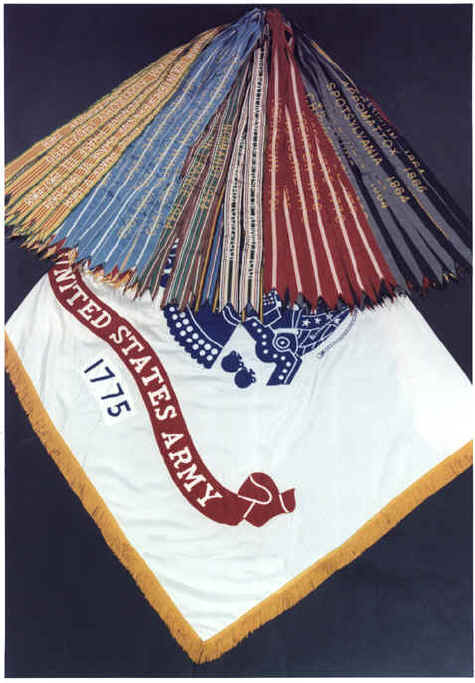
Army ColorsLinn’s concepts bring to mind Russell Weigliey’s The American Way of War a History of the United States Military Strategy and Policy. He builds on Weigliey’s work providing significant new understanding.
Weigliey’s major theme was that when circumstances allow the American Way of War is to seek out and destroy the enemies armed forces and/or ability to wage war. Attrition and indirect strategies are only adopted out of necessity. When the enemies ability to wage war is destroyed the situation is turned over to the politicians and diplomats for a political solution. Both Linn’s Guardian and Manager traditions are different ideas on how to do this. Even the Hero tradition, which sees the need for the political solution sees a military solution as perquisite.

Another of Weigley’s themes was the dichotomy of a Regular Army that thinks it’s mission is to fight European type armies, the most difficult and dangerous opposition, and directs most it’s intellectual effort is how to fight them - but spent most of it’s history as a frontier and later colonial constabulary fighting indians and guerillas, the most common mission. In Linn we see that contrast in greater detail. While their documentary history is not as clear, Linn shows that the Heroes represent a constant intellectual tradition in how to prepare and fight wars, which has made a major contribution to the Army. Weigley writing from the Manager tradition tends to see them as outside the intellectual tradition of the Army.


One thing that struck me was how often the “datum” that was missed by all three traditions in planning for the next war was the future decisions of our political leadership. One of the best examples Linn sites is Lieutenant General John Schofield, then a former General in Chief of the Army saying that “foreign conquest and permanent occupation are not a part of the policy of this country” and just over a year later the US declared war on Spain. Since this was not a policy of the country there was no need to prepare the Army for it. In stating this I think Schofield was not only stating his strong personal and professional values but the prevailing consensus in the country. He would most likely have been pilloried if he had said “foreign conquest and permanent occupation are a part of the policy of this country” To a greater or lesser degree the possible conflicts envisioned by our political leadership, and which the Army was directed to prepare for, were not the ones that developed. But then if the political leadership had envisioned them they may have prevented them.

While Linn limits the topic to the Army’s internal debates, these traditions seem, especially since WWII, to reflect the similar views of the broader defense community and to US perceptions on warfare generally. The traditions exist (and perhaps others) across the Defense Department and broader defense community. Except for breaking discussions into manageable portions I am not sure the Army’s intellectual discussions can be still treated independently of the larger Defense discussion. For example, he sees the Wineberger/Powell Doctrine of fighting only for essential national interests, with popular support, in quick overwhelming decisive campaigns as an expression of the Guardian tradition. But the Rumsfeld “transformation” is also an expression of the Guardian tradition. The difference being the Wineberger/Powell envisioned a key role, in conjunction with the other services, for the Army (a role with which the Army was comfortable, perhaps too comfortable); but Rumsfeld’s vision gave the impression that the eventually the Army would be relegated to base guards and target spotters. This may help explain why the Army did not get along well with Secretary Rumsfeld. I get the impression that pre-9/11 the Army was only a marginal, and perhaps unwelcome, participant in much of the discussions that led to the “transformation” policy. It is not enough that the Army's three traditions are in discussion with each other but they must also be in a serious discussion with their counter parts in the larger Defense community, to ensure the oppertunities and problems of ground combat are taken into account, and the Army receives instructions to prepare for a future war that has a basis in reality.


The Army prior to 9/11 was not prepared to fight the Cold War/World III, as the accusation I began this post claims, it was prepared to execute the Wineberger/Powell doctrine, the last coherent political direction it received. This was useful for “major combat operations" in Iraq: but was not what was needed or the “minor combat operations” that followed. The Runsfeld transformation doctrine weakened the march to Baghdad and except for providing good air support weapons was not much use for fighting the insurgency. Of course an insurgency is a “Hero’s war."


Summary

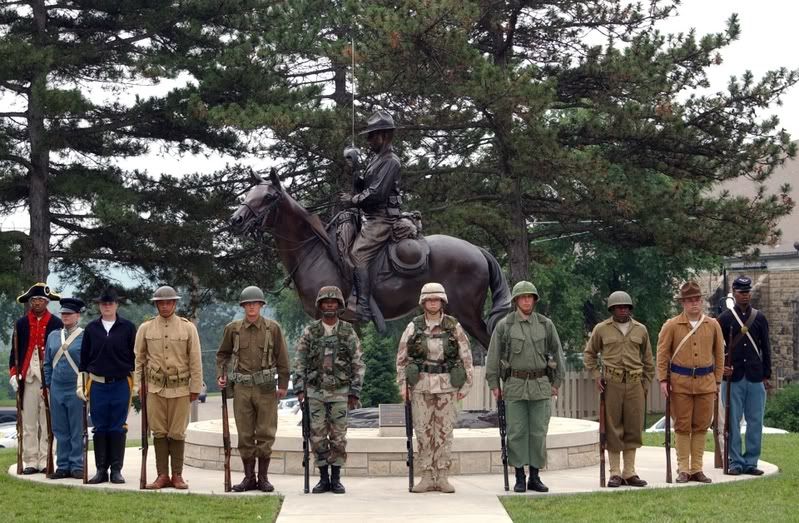
Solidiers 1775-2007Best quote from the book. Linn quotes General Tommy Franks saying; “I’m a warfighter, not a manager”. In the footnote he comments “Franks is quite correct in his assessment of his managerial abilities”
This is a well written book that should be mandatory reading for Army officers and any one with a strong interest in military policy. For those who would only read two or three books on the subject The Echo of Battle should be one of them. STRONGLY RECCOMENDED,


Brian McAllister Linn is a History professor at Texas A&M University and the author of U.S.Army and Counterinsurgency in the Philippine War 1899-1902, The Philippine War, Guardians of Empire, The U.S. Army in the Pacific 1902-1940 All of which are excellent. The Philippine War is an example of how military history should be written.


See Also

Reviews of Parameter articles.
Military Culture Wars
War Termination


Other
How Not to Fix the Military


N.B. The pictures other than book cover are US governemnt art and in the public domain.


See Also

Carriers in the West Pacific
How Not to Fix the Military

Saturday, January 17, 2009

Book Review: The Traitor

Grigori is a traitor. But whom and how many has he betrayed?


Book Review: The Traitor
Author: Lvar Divomlikoff
Publisher: Popular Library, 1976
Originally published in French as Le Traitre.
By Editions Robert Morel, 1972


This novel tells the story of Grigori, KGB officer at the end of World War II, who is offered a twenty-year mission to infiltrate the Russian Orthodox Church. Twenty years later he still thinks in his mind that believers are suppositious fools, but when meeting with his superior, his first thought is how to save the superior’s soul. His superior tells him the mission will be terminated. He is to write a letter to a noted professor ”confessing” his error in being a priest, denouncing the Church and the faith, after which he will be given a cincture as a professor of atheism at the university, and undoubtedly serve as a spy there.


He first walks into a seminary and states he had a conversion during the war and wants to be a priest. He is accepted with little checking because it is impossible in post war confusion. After three years while the seminary is being closed by local authorities, he attacks the soldiers who are closing it against the instructions of the Rector. He is thrown in jail by the local police who know nothing of his mission. In doing this he has betrayed both the Church and the Service.

After letting Grigori stew a while and a solid reprimand the KGB gets him released with instructions to find the proper authorities and be ordained. In the Orthodox Church one can be ordained a celibate monk or after reaching a certain age as a celibate priest. Otherwise he has to be married. To be a Bishop, which is the eventual goal, he has to be a celibate monk or priest. The last surviving member of the faculity recommends him as a priest but not a monk. He is too young to be ordained without being married. But in looking for the proper authorities he met a girl who dreams of being the wife of parish priest. He proposes and she accepts. He does not see this as a problem to becoming a Bishop because she can be run over by truck in a year or two. He is validly, if sacrilegiously and blasphemously, ordained.

He spends the next seventeen years in several parishes; to maintain his cover he enthusiastically performs his priestly duties, often illegally. He becomes influential in the affairs of the Church. His wife’s tenderness wins and softens his heart, and she makes the best borsht in the world.

Grigori turns in his “confession.” Waiting for the summons to be recalled, he celebrates what he expects is his last Divine Liturgy, glad that he will never participate in that farce again. At the consecration he bows, comes up, and Christ is present on the altar. A fact of which he is absolutely certain. He does not like it but a fact is a fact, the party and KGB are wrong and the Church is right. Pondering on his way home to some of his wife’s borsht he is arrested.


His mission is reviewed under torture, his new faith gives him the strength to survive it, but he is never asked the question about his current belief that would send him to a firing squad. He passes the test, his wife is run over by a runaway truck and he is released from jail. Between his reputation, his witness to the faith under torture, and KGB string pulling, he is ordained a bishop. He confesses the truth to the Patriarch who tells him not worry, there is plenty of time for martyrdom and he will do much good before the KGB figures it out.


This psychological drama is good read. Mildly annoying is the translator used the terminology of the Western Church in describing the Russian Orthodox Church. The plot is completely in agreement with everything I have heard of life under the Soviets. Long out of print if you find a copy it is worth reading.

I found this book which I read a long time ago while moving things at home. The story has remained with me especially since the fall of the Berlin Wall. As the news stories of how the Church survived and of clergy at various levels of loyalty came out my mind ran back to poor Grigori. No great lessons just a context to view the events.

If he survived until the overthrow, a Grigori would have betrayed to many to ever be restored to anything more than a back pew parishioner, but there is the strange irony that to maintain his cover he was a more effective priest, who brought Christ and salvation to more people, than a sincere priest could ever have done without being arrested. And he betrayed them to martyrdom.


Pray for the persecuted Church everywhere.

Related (added 11/12/11): Resurection

Sunday, January 04, 2009

Book Review: The Quest for the Lost Legions

The Emperor Augustus looked at the severed head of Publius Quinctilius Varus and cried

“Give me back my legions!”

Varus was long past answering, but for centuries people have pondered the question of just how did he go about losing three legions of professional soldiers to what is essentially a tribal militia. This book describes the latest chapter in the The Quest for the Lost Legions.


Quest or the Lost legions

The Quest for the Lost Legions, Discovering the Varus Battlefield
Author: Major Tony Clunn
UK Publisher: Spellmount Limited, Staplehurst, Kent, 2005
US Publisher: Savas Beatie, New York, New York, 2005

Tony Clunn’s webpage
Kalkriese Museum
Imperium Konflikt Mythos
Official 2000th Anniversary site.


The Battle of the Teutoburger Wald in the fall of 9 AD, though always listed as one of the most important battles in world history, was an event of some mystery since the location of the battle was somewhere in German Forests and the historical sources are summaries written by later authors. It was known that Varus lost three legions and auxiliaries to a coalition of German tribes lead by Arminius an auxiliary officer in Roman service, the political shock to Rome was tremendous, and precipitated a change of frontier policy by Rome. In 1989 the author Tony Clunn, a British Army officer stationed in Germany, and an amateur archeologist, discovered some Roman coins in the vicinity of Kalkriese in Northern Germany. Additional discoveries proved his theory that this was the location of the Teutoburger Wald battle. This is one of the most significant archeological discoveries in recent times.


The book has two story lines, the discovery of the battle site and Clunn’s other explorations in northern Germany interweaved with a fictional reconstruction of the Battle

The Search.

Clunn tells the story of his discovery, armed with an avocation for Roman history a metal detector and some military common sense, discovers the long lost battlefield. He rather downplays that he had already done the available archive research on the subject, talked with the last person who had found a Roman coin at the site. Using this information and a soldier’s eye for looking at the ground; his selection was an informed estimate rather than a lucky guess.

He provides a good example of how an amateur should work with professional archeologists. First he got required permissions to conduct a survey and then kept the professionals informed. When enough evidence came to light to make this an official project he kept in the background, maintaining an interest and helping but never working at cross-purposes. A major dig is expensive, where as Clunn could just get the permissions and search on his free time. One of his biggest achievements was to do the preliminary searches on his own and find the discoveries that could justify a major project. He also tells of his subsequent efforts to find related sites which will take further searching to confirm his theories.

Clunn’s telling makes the story of the archaeological discovery an adventure.


Reconstructing the Battle.

The principle Roman character is Marcus Aius the Tribune second in command of the Army. (Cloak clasps belong to a Marcus Aius were found in Kalkriese though real Marcus was of a much lower rank.) A professional solider to Varus’s politician he tries to convince Varus to maintain a more combat ready posture and he also suspects that something is wrong and that Arminious is behind it but he does not have the hard evidence that will convince Varus. After Varus and many of his top commanders committed suicide he leads the legions in a last desperate attempt to escape and unknowingly leads them into the ambush at Kalkriese.

The principle German character is Arminius who has been working for a least a year to destroy the Varsus's Army, building alliances with the tribes, giving advice to Varus that leaves the Romans exposed, training his forces and preparing the battle site. He knows the tribes cannot stand in open formation against a Roman legion so he plans to draw them into a route where the Romans can be ground down in many small attacks and ambushes culminating in a major trap at Kalkriese where it will be destroyed. All the while pretending to be loyal officer in Roman Army.

This is a possible reconstruction that explains how one goes abut losing three legions. It does a good job of integrating the historical sources and the archeological discoveries. The route he picks seems to be very long but not impossible. The best features of this account are seeing the ground and situation with a soldier’s eye, and giving the feel of a professional army to the Roman command.


The book tells both stories with a clarity that can engage the general reader but still be informative to readers with more background. The photographs add to the story. The maps are adequate. Recommended.


Related:
The Battle That Stopped Rome by Peter S. Wells
Book Review: Rome's Greatest Defeat By Adrian Murdoch
Eagle in the Snow by Wallace Breem
Friday Snippet


Topic:
Rome

Wednesday, April 09, 2008

Book Review: Left to Tell


Left to Tell – Discovering God Amidst the Rwandan Holocaust

Immaculee Ilibagiza
Hay House, 2006
Left to Tell Fund
Left to tell


Most everyone knows in general that in 1994 there was a genocide of over a million people in Rwanda as the world stood by. Numbers so large we lose any sense of individuals. Immaculee Ilibagiza rivets us the events as they happened to her, her family and acquaintances as she was one of the few who was left to tell their story

From the life of a child in a loving family and a student who is only loosely aware of national politics she is suddenly thrown into the maelstrom of a Civil War that turns into genocide against own her people. Hidden in a bathroom for three months with seven other women she emerges to find her family dead, many whom she had thought friends had been part of the killing. She learns that the only way survive as a human being, not just some one who was not killed, means she has to have faith and trust in God and forgive those who killed her family and friends.

The surreal horror is seen in joy of finding a friend she thought dead, and finding out he was hidden by someone who went out every day to join the killers.

This is a riveting well written account that should be mandatory reading for every one.

Many things can be said about the genocide, but is perhaps best to remind ourselves of the teaching of the Catholic Faith that gave her the strength of survive.

Look in the mirror - the person looking back at you is not so very far from being the hero or villain in a similar situation. Pray that Christ’s Grace and Mercy give us all the wisdom to see the difference and the strength to act.


Grant them Eternal Rest Oh Lord, and let your Perpetual Light shine upon them.


------------------------------------------


See Also

R J Rummel’s Power Kills Site Most every thing you want to know about Genocide and more.

What is Genocide

Book Review: Death by Government

Genocide/Democide Topic.

Friday, September 28, 2007

Book Review: Mapping the Civil War

Mapping the Civil War

Book Review:
Mapping the Civil War: Featuring Rare Maps from the Library of Congress
Authors: Christopher Nelson, Brian Pohanka, Library of Congress Geography and Map Division
Publisher: Fulcrum Publishing, 1992


This book is part of the Library of Congress Classics series. In addition to reproductions of civil war maps, it has contempory sketches and photos, a good narrative history of the Civil War, and some short but detailed essays on the maps used and mapping during the different campaigns.

The narrative history is excellent for giving the novice student of the civil war an overview of the main course of the war. The pictures give a very realistic feel of what the war was like with out being overpowering.

Of course the maps are the interesting things. There are reproductions of maps from all theaters, levels of organization, uses, and quality. They provide a full panorama of the maps used in the Civil War. It is one thing to know in theory that they did not plan a campaign using EarthGoogle. Instead they had maps that were drawn on a very small scale, had roads and key features missing or not correctly located, to plan the movement of very large forces. That the armies often literally did not know where they were, explains much of confusion of the war especially early in the war.

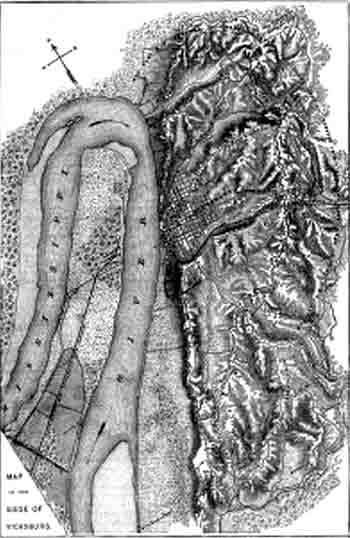
Vicksburg 1863 Library of Congress

This is a map of the river in front of Vicksburg MS. (It is the lead map on the in the chapter on the Vicksburg Campaign.) The union gunboats and barges running this stretch of the river under fire from the town bluffs is one of the great sagas of the war. But usually there is not a map or it only shows the river in front of the town not the full hairpin turn. Here you see the tricky navigation that was carried out at night along a course where there could be no surprise.


What I found especially interesting were the excellent large scale maps of fortifications, positions and battles that show considerable skill in producing a map when time and surveying resources were available. Individual units or officers, rather than the Topographic Corp, drew many of these maps. This is a skill that is vanishing since much better can be done with computers and aerial photography.

At the beginning of the war the US was mapped in a rather haphazard manner. Collecting maps, drawing new ones, reproducing, and distributing them was a major challenge for both sides. As the war progressed each side developed a better “data base” of areas in which they operated. Reproduction facilities and efficient distribution methods were set up. When it was decided that an army was going to move from point A to B relevant maps were prepared, reproduced and distributed in a few days and available before the movement began. With its greater industrial capacity the Union did better than the confederacy but the confederacy made significant improvements. The best use was General Sherman’s Atlanta Campaign where one map was developed from the best intelligence that could be had, and every one who needed a map was using the same map. There were actually orders issued like “defend by the letter ‘O' in word 'Mountain'” a sign of high quality maps that had the trust of the users. The topographic staff was part of General Thomas’s Army of the Cumberland, which did most of the logistics work for this campaign.

Maps were prepared by the US Coastal Survey and Army's Topographic Corps, most Topographic Corps' officers stayed with the Union at the beginning of the war. Many volunteer officers who had surveying or drawing skills served on both sides. The best of them was Jedediah Hotchkiss, the principal of a small school before the war, who was Lee’s mapmaker. In the Washington-Richmond theater the Confederates almost always had better maps do to his efforts. When the Union captured his maps the Union reproduced and distributed them. There was an injustice to the officers of the Topographic Crops, they were so valuable in that role they would not be released to command regiments brigades and divisions, with the appropriate promotions that many Regular Army officers in other branches recived. None the less they performed excellently thought out the war.

The only problem with this book is that many of the maps are not reproduced on a scale that allows you to use the actual maps used by the armies to follow the action.

This is an excellent book assessable to all levels, well written with good pictures and maps. I would say that for a person is only going to read one book on the Civil War this is a good candidate. If you are person who likes maps this is a gold mine.

Sunday, June 17, 2007

Book Review: Murders Do Not Come by Accident

Book Review: Murders Do Not Come by Accident.
Edward T Cook
Page Free Publishing

Photo Sharing and Video Hosting at Photobucket

John Cook retired as a detective from the Chicago police force to Marquette in Upper Michigan where the local police chief recruits him as a detective. Four fatal accidents happen in rapid succession. Nothing exciting in themselves, but together they crate a pattern that suggests murder. His investigation leads to the center of the local drug ring.

Good summer reading, and a detective who actually knows how to develop the evidence to get good search warrants.

Friday, May 25, 2007

Book Review: Eagle in the Snow

Photo Sharing and Video Hosting at PhotobucketBook Review: Eagle in the SnowGeneral Maximus and Rome’s Last Stand.
Author Wallace Breem
Orion Books, DBA Phoenix books, London, UK 1970


In the winter of 406-407 the Rhine froze solid. The German tribes crossed on the ice into Roman territory. Not a just a raiding party, but a migration of entire nations who’s invasion completely disrupted the Western Empire. The provinces of Gaul never recovered, Britain passed from Roman rule, eventually Hispania, and North Africa and Italy were invaded. This novel is the story of the Roman commander’s account of the defense of the Rhine and his eventual defeat.


Paulinus Gaius Maximus was what we would call an Army brat. Of Equestrian (knightly) Roman stock he was raised in legionary garrisons as his father rose through the ranks to be the Legate of the Legio XX Valriea Victrix. He followed his father into the Army first as an Equestrian Tribune in his father’s legion before moving on to other assignments. From his father and this service learned the ideals of an earlier Rome and Roman Army, a loyalty he will serve the end.

Maximus is the son of a military family that ended up on the wrong side of imperial politics, a pagan when favor was increasingly going to Christians, but talented well above average and apolitical himself he is appointed as the Prefect (Commander) of a cohort at a critical fort on Hadrian’s Wall . A dead end job he will hold for over thirty years but he performs it well and occasionally with distinction. He learns the skills that will do him well on the Rhine

Sometime after 395 Flavius Stilicho, Commander of the Roman Armies in the West, visits Britain, and impressed with Maximus he offers him command of his fathers old Legio XX Valeria Victrix, which he is talking out of Britain to help defend Italy. The XXth has been allowed to run down to the point that is a parody of its old self. Maximus has a year to recruit it to full strength restore it as a fighting force, not the old heavy infantry legion but a modern force with both heavy and light infantry as well it’s own cavalry. A year later when he joins Stilicho he has force of 6000 men including 1500 cavalry disciplined to the standards of the old roman Army and trained for the new warfare.. After campaigning in Italy for five years Stilicho gives him a new mission in Germany. The Rhine is only garrisoned with enough forces to restrict raiding. The German tribes east of the Rhine are being displaced by the Huns and want to migrate into Roman territory, a migration that Rome does not have the ability to absorb. The mission is possible in theory because there is only one stretch of the Rhine from Worms to Koblenz where whole tribes could migrate as opposed to launching raids. This is for only a few months of the year in spring and fall, and without bridges there is a limit to how many can cross at one time. Unless the Rhine freezes.

For a year and a half Maximus struggles to make a backwater command into a fighting force, and uses bluff and bluster to convince the Germans not cross until he has built the army. He gets little willing support from the local governments or from the government in Gaul. Gradually he builds the army, the XXth as the strike force and enough Auxillaries to hold defenses. His single mindedness and integrity win the respect and even some support from the local government as well as the very grudging respect of the German leaders. But then in December 406 the Rhine freezes and on the thirtyfirst the tribes cross. After three weeks of fighting, holding with bravery discipline and skill, losing to numbers and treachery, he makes the last stand. The Eagle of the Legio XX Valeria Victix, which lead the legion for over 430 years, is melted to prevent capture while they await the final charge.


I think a point the modern reader should take away is how fast civilization can dissolve and how terrible the result would be. The introduction begins:

In the deep valleys between the black rain-lashed mountains of the western coast there is little to do of a winter’s night if you belong to a beaten people. Defeated sick of heart and afraid, you sit huddled in tattered cloak round the great sputtering fires and dream of a tomorrow that will never come. The women nurse wailing children and long for warm huts and a world in which milk is always plentiful; the young warriors sharpen their dulled spears and pray for just one victory against the men from the sea; while the old remember a time when no fires betrayed a burning village to the night sky, and there was peace in the lands from which they are now exiled for ever.

Seventy, even fifty years ago one would never see a village burning in the distance, a general peace from the Pillars of Hercules to the wall of Hadrian, from cliffs Brittany to the mountains of Italy. Men who did not join the army did not have to dream of defeating an all to likely enemy, and mothers could be sure they had enough food to have milk or could find a wet nurse. Old men remebered long ago harvests and places they safely gone and returned.

What brought this about? Well many factors but one that is key to the novel is that the upper classes of Rome had stopped believing in the ideals that made Rome. And not believing they did not act. We should not forget the if we lose the ideals that made western society and our country we could be not to many years from a similar collapse.


This is an excellent novel, well set in the larger reality of the time and place. The suspense is not in how it will end, (it’s in the notes on the cover) but in the fight against man nature and events. Maximus is a very believable character; the depictions of events ring true. The author served in the British Indian Army on the North West Frontier in World War II, which brings a strong sense of reality the account of border duty and role of the Auxiliary units. There is a good map that makes the major action clear as well as lists of key terms characters and historical events.

Strongly Recommended.

Related
Book Review: The Fall of the Roman Empire

Book Review: Rome's Greatest Defeat
Book Review: The Battle That Stopped Rome
The Advanced Guard
Copyright 2004-2012 - All rights reserved. All opnions are mine, except comments or quoted material - who else would want them. Site Meter