Saturday, June 04, 2005

A Test

.

Jesus and Satan were having an ongoing argument about who was better on his computer. They had been going at it for days, and God was tired of hearing all the bickering.

Finally, God said, "Cool it. I am going to set up a test which will take two hours and I will judge who does the better job."

So Satan and Jesus sat down at the keyboards and typed away. They moused. They did spreadsheets. They wrote reports. They sent faxes. They sent e-mail. They sent out e-mail with attachments. They downloaded. They did some genealogy reports. They made cards. They did every known job.

But, ten minutes before the time was up, lightning suddenly flashed across the sky, thunder rolled, the rain poured, and, of course, the electricity went off.

Satan stared at his blank screen and screamed in every curse word known in the underworld!

Jesus just sighed.

The electricity finally flickered back on, and each of them restarted their computers.

Satan started searching frantically screaming, "It's gone! It's all gone! I lost everything when the power went out!"

Meanwhile, Jesus quietly started printing out all his files from the past two hours. Satan observed this and became even more irate.

"Wait! He cheated! How did he do it??!!"

God shrugged and said, "Jesus Saves."


Thanks to Jana B

Monday, May 30, 2005

Memorial Day

.

Let us Pray

Father

Today, though mindful of our faults, we remember those who have died in the service of their country, for it was your Son who taught us that there is no greater love than he who gives his life for another.

We ask you to take those who have died into the warmth of your presence.

We ask for strength an comfort for their families.

We ask that those who were wounded have a speedy recovery and a long and happy life.

We thank you for those who have retuned safely home.

Most of all we ask that we will never have to add to the list of those we remember this day.

Thy will be done.

We ask this through our Lord and Savior, your Son Jesus Christ, and in union with the Holy Spirit.

Amen

Thursday, May 26, 2005

So much effort

And nothing to post.


I tied an experiment with changing the format. I did not like the result and attempted to change it back. It came up worse. And Blogger was showing an error.


Blogger help lived down to it’s reputation.

Between Google and having made multiple backups I got fixed (I hope – fingers are crossed!)

Wednesday, May 18, 2005

The Unorganizd Militia II

TM Lutas of Flit TM whose posts on the Unorganized Militia prompted writing my the previous post on the Unorganized Militia post sent an Email with some very pertinent comments.


I'm working through the source material right now but I think you haven't captured the reality of the thing. If the people are sovereign, they must, at some level, have the right to violence. I challenge you to construct a meaningful construction of sovereignty without it. At the same time, if we are not to have anarchy, such violence must be restricted and channeled in a reasonable way. I submit that the idea of an unorganized militia is an appropriate form for channeling and molding the necessary recognition that the people themselves have the right to do violence if they are to remain sovereign.

Thus it is not correct to say that the unorganized militia is not a part of the common law except insofar as the label itself seems to be of relatively recent vintage. The map is not the country and the label is not the thing itself. Sovereignty is meaningless without violence. Now normal people don't talk of such things on a regular basis. They are left between the lines, implicit and hopefully never used as there is no need. Those who tend to discuss this as a day to day affair tend, as a real world observation, to be obsessed nuts. That doesn't mean that they are in error, merely grossly counterproductive to their cause.

My wife doesn't generally bring up the topic of surgical removal of fingernails at mealtimes unless it is apropos of something that is mealtime conversation. That doesn't mean that she doesn't know how to do it or, when called for, will do it. Popular sovereignty and its attendant right to violence are similarly not for everyday conversation. It's also unrealistic to assume that government will be particularly eager to recognize the fact that it's not ultimately in charge in the US system.

The militia law, I would suggest, is a governmental attempt to restrain and channel this inherent right of a sovereign people to ultimately defend their lives, property, and liberty. Like a police choke hold, restraint in moderation is entirely of a different character than when it goes overboard, and results in death. There are rules for police choke holds and there are restrictions on the ability of the state to restrain the militia. In the US case, the regulation of the "choke hold" is in the text of the 2nd amendment, something that I find astounding that you did not include in your analysis. The entire bill of rights was written to prevent a government run amok from running roughshod over the rights of the people. Any assertion that militia are only creatures of the state have to at least confront the 2nd amendment. You have not done so. You may wish to correct that.


It would seem to me that reality of the thing is there are two issues. They are somewhat entwined because of their history but they should be considered separately. First is the right of people, individually and collectively to defend themselves. The second issue is what is the Militia? I think TM's disagreement is over the second issue. We seem to agree on the importance of the first.

If the people are sovereign, they must, at some level, have the right to violence. . . At the same time, if we are not to have anarchy, such violence must be restricted and channeled in a reasonable way.

Correct. They form a government. If the country is invaded and government does not or is incapable of defense, the citizens have the right to rise as a levee en masse. If the government becomes oppressive they have the sovereign right to remove it. Neither of which depend on the Militia, and exist even when there is not a militia.

The first function of government is the collective defense of its population against violence, foreign and domestic. And ironically, since governments end up with a virtual monopoly on the instruments of coercion, a government can be the biggest threat to the people it is supposed to protect.

The militia never included every one, for example women, but women also have the right to self-defense. Exercising rights to self-defense does not require a militia. TM sent me a link (see comments in the orgianal post) about Condolizza Rice’s father and friends patrolling their neighborhoods with personal weapons to protect against racist violence. They were individuals not a militia. But they were exercising basic human rights.

This is also why the Second Amendment right to keep and bear arms is not dependent on the militia, women have the right to keep and bear arms. The reference to a militia in the Second Amendment is preamble to state a reason why the right is important. Also since originally the Bill of Rights applied to the federal government, it made it impossible for the Federal Government to made an end run around the States duty to regulate the militia by infringing directly on the right to keep and bear.

The protection of basic human rights is dependent on a “democratic” system with a solid respect for the rule of law, that diffuses political power so that no one person or group can get in position to abuse rights. Related to this is a diffusion of the means of governmental coercion, i.e. state and local police instead of a national police force so that no one can control every thing. The militia was a good example of this, even though in theory a single military force its wide local administration made it impossible to use the militia to enforce any laws without wide spread consent. And a reason why, even though the classic militia structures are outdated, a major portion of our defense should rest with the National Guard and Reserves.


The militia is a means for the government to fulfill its duty to protect its citizens.

The militia law, I would suggest, is a governmental attempt to restrain and channel this inherent right of a sovereign people to ultimately defend their lives, property, and liberty.

In addition, I would rather suggest that the Militia system was brought to the colonies as the only economically feasible means of providing for defense. It still remains part of the Governments repertoire to “execute the Laws . . ., suppress Insurrections and repel Invasions.”

it is not correct to say that the unorganized militia is not a part of the common law except insofar as the label itself seems to be of relatively recent vintage. The map is not the country and the label is not the thing itself.

If it can be established that the thing itself existed, this would be a good point. I know of no examples of an “English” militia that exists separately from statutory or executive authority. Except for the American Unorganized Militia I know of no example where people who do not meet for training and have no structure are by design classed as a militia. Militias were always established by an action of the King, a legislature, a Lord or who had the right, or a person acting on delegated authority. Remember the Mutiny Act that made it illegal to raise an army without the permission of Parliament. This was a constitutional/statutory restriction on the Monarchs exclusive power to establish military forces. Up until then this was a purely Royal prerogative provided he had the money. Of course the Militia is not a standing army, even today if a group attempted to establish a militia in England without authority from Parliament they would be prosecuted under the successors to the Mutiny Act.

The Unorganized milita is an administrative category to account for the difference between a constitution that assumes a univeral militia and the fact that there is only a need for a small number of persons training in units. Simply the Constitution reserves to the States the Appointment of the Officers, and the Authority of training. The unorganized milita is a part of the milita that does not have officers appointed or authorty for training. The Congress and legislature provide laws for the calling of the milita. Only two or three states have a law that governns calling the Unorganized Milita, basically, report as individuals at the time and place the governor designates. Without officers, training or a valid way to call them out, the Unorganized Milita is incapable of fufilling the funcitions TM would like. The militia movement organizations cannot be classed as a real milita since the state did not appoint their officers or authorize training.


I think the confusion arises because in our early history there was:

1) A strong distrust of a standing army, given the manner in which the Parliementary and Royal goverments administered, used, and abused the standing army in the 1600’s this was a very reasonable opnion. An opnion reinforced by the Crown’s arbitary use of the Army in the colonies (where the Mutiny Act restrictions did not apply) just prior to the Revolution. Thus the Militia became the model defense organization in the popular mind.

2) The very entwined role of the local militia company in the life of a village blurred the distinction between the governmental establishment of the militia and the nrights of citizens.

3) The American Revolution was a revolt of the Colonies/States against the Crown. Since the militias were controled by the state legislatures, the calling the milita was a natural option. The action of the State Governments in calling the Militia be came confused with indivduals standing up to tyranee.

4) since it is not a topic of every day convesation it is easy for mistaken ideas to take hold.

While entwined in actual use in American history the basic human right of collective self-defense and the organization of the militia are separate things. In the nornal course of things the people exercise their "soverign right to violence" to "ultimately defend their lives, property, and liberty" by forming a governments. In our case the government established by consititutional/statuatory law the militia as one means of exercising this right.

Monday, May 09, 2005

The Unorganized Militia

When the United States was established the founding fathers assumed that the militia would be the backbone of our defense. While it has not worked out that way, the militia clauses are still in the Constitution and law. Many people have a poor understanding what of the militia is, especially the Unorganized Militia. Many assume that the Unorganized Militia is some sort of Common Law structure that exists independent of governmental action, and that consequently citizens can on their own initiative organize themselves as a militia, because they are members of the Unorganized Militia. This understanding has given rise to the so called:”Militia Movement” a series of organizations that have formed themselves to be “militia”. However, this does not agree with the historical record, not is it consistant with intent of the authors of the constitution and laws governing the milita.


To understand the constitution's provisions for providing the common defense, reviewing them is a good place to start.

The US Constitution provides for a Militia. The Congress may establish laws:

Article 2 section 8
Clause 15: To provide for calling forth the Militia to execute the Laws of the Union, suppress Insurrections and repel Invasions;
Clause 16: To provide for organizing, arming, and disciplining, the Militia, and for governing such Part of them as may be employed in the Service of the United States, reserving to the States respectively, the Appointment of the Officers, and the Authority of training the Militia according to the discipline prescribed by Congress;


These clauses assumes that every one knows what a militia is, thus there was no need to provide a definition.

This is different than the Army and Air Force which Congress established on the authority of

Clause 12: To raise and support Armies, but no Appropriation of Money to that Use shall be for a longer Term than two Years;

Title 10 Section 311 b) 2) of the US Code is the enabling statute:

(a) The militia of the United States consists of all able-bodied males at least 17 years of age and, except as provided in section 313 of title 32, [NOTE: members of the regular services] under 45 years of age who are, or who have made a declaration of intention to become, citizens of the United States and of female citizens of the United States who are members of the National Guard. b) The classes of the militia are - (1) the organized militia, which consists of the National Guard and the Naval Militia; and (2) the unorganized militia, which consists of the members of the militia who are not members of the National Guard or the Naval Militia.

It does not state duties or functions of the Unorganized Milita, which must be determined from the legislative history and case law regarding the Militia.

However state laws sometimes provide for three classes of militia. For example:

9‑8‑102 (c ) The Wyoming code defines the States Militia as:

a) The militia of the state is divided into the organized militia and the unorganized militia.

(b) The organized militia consists of the following:

(i) Such elements of the land and air forces of the national guard of the United States as are allocated to the state by the president, the secretary of defense or the secretary of the army or the air force and accepted by the state, hereinafter to be known as the Wyoming national guard; and

(ii) Wyoming state guard forces, when organized.

(c) The unorganized militia consists of all persons liable to serve in the militia but not commissioned or enlisted in the organized militia.


Twenty-five states have State Guard forces.

The Constitution and Federal and State Law authorize a militia, provides for two types of organized Militia and an Unorganized Militia. But there are no detailed definitions in the constitution or law. To see how we got here and what the founders and Congress intended by the different types of militia, we need to look at their historical development.


The Royal Charters for the first Colonies gave them the right to establish militias. These were a continuation of the English Militia system. They were always organized. For each town a company was established and for each county a regiment. Officers were appointed, usually selected by election by unit members, but the commission was from the Governor. Every able-bodied white male between the ages of 16 and 60 was a member, required to provide himself with a suitable musket and equipment. (In modern terms we could say that the Colony was providing for defense by imposing unfunded mandates on the local government and citizens.). After independence the militia continued on the authorization of the state constitutions. After the US Constitution came into effect Congress passed the Militia Act of 1792 providing a common framework for the militia and calling the militia into Federal service. Under this law the President could call a states militia into the service of the United States for 90 days. But this required the permission of the governor, and the militia could not be deployed outside the US. Except for the 90 day requirement these were considered implicit constitutional requirements. When longer terms of service in wartime were required, the President called for volunteers by state who were mustered into the Army (Clause 12 above) as Volunteers. Volunteer army units were often based on militia units.


The company met for muster four times a year. Sometimes a regimental muster would be substituted. If there was a danger of foreign or indian attack the muster could be monthly or in a few cases weekly. If someone did not attend they had to pay a small fine. If they did not have the proper equipment they paid a fine. Muster day consisted of close order drill, musket drill, and maybe some skirmishing practice in the morning. Target practice was seldom done - the militiaman had to pay for their own ammunition. The afternoons were usually a town picnic paid for by the fines of no shows. Families came, and a good time was had by all. If there was a serious danger of attack the afternoon would also be drill and the fines would pay for target practice.

These local Militia companies served several purposes. They provided a rudiment of training, served as a home guard if the town was attacked, and provided a basis for recruiting volunteer forces to help protect other parts of the colony. When a volunteer force was needed, each company would be assigned a quota. If volunteers could not meet the quota the Captain would select who would be drafted to meet the quota. Theoretically the whole unit could be drafted. The few times militia units were drafted for any thing other than home guard duty were usually a disaster (i.e Bladensburg in 1814 and the burning of Washington.)

As the country became more settled, musters, attendance, and even the collection of fines became infrequent and eventually stopped. By the 1840's states were amending their laws to end the muster requirement. Commissions were granted for a time in these non-drilling regiments as a matter of social prestige, after the Civil War so many community leaders had held war service volunteer commissions that a militia commission provided no prestige and the practice was gradually discontinued.

From colonial times there was a different type of militia unit. Often called "volunteer militia." These were completely volunteer organizations that were first organized to provide the high cost units such as artillery and cavalry, often composed of the more prosperous members of the community who provided their own horses and purchased the cannon out of pocket. Later infantry units were organized. From the 1850’s or earlier these were the only militia units that received training. These units provided the backbone of the units that were called up in major wars and are the ancestors of the current National Guard. But because they were militia they could not be called without the permission of the state governor. If volunteer forces were needed for a major war the unit would vote on whether or not to respond, sometimes they voted no. In some places they were excessively involved in local politics. Training was of varying quality. (To confuse the issue some general militia units over time evolved in to volunteer units.)

This is the status at about 1900. On paper, all adult males were members of the militia, but only a small number actually were part of units that met and trained. The laws governing mobilization assumed the original concept of a universal militia. The militia laws also restricted the militia from any useful deployment. The wartime calling of volunteer units was a partial solution not suited to creating a modern Army in wartime. During the first 20 years the last century there were a number of reforms moving the Army out the 19th century into the 20th, The militia reform was an essential part.

The Dick Act (1903) and the 1916 and 1920 National Defense Acts created the basis for the modern Reserve and National Guard units. National Guard units (state militia) received federal funding if they met federal standards and were available for call up. Reserves for the Army that were not part of the state militia were authorized. All able bodied males who are not in regular services or the organized militia are by default members of the unorganized militia. The part of the organized militia enrolled in the National Guard is funded by the federal government, and administered by the states. States could from other militia units at their own expense.

The 1916 National Defense act established the Unorganized Militia is an inactive administrative category to account for the discrepancy between constitutional provision that assumes all able bodied adult males are members of the militia and the fact that current militia organizations are voluntary and only have a small minority of citizens as members.

The 1920 Act made clear that the National Guard was both a state militia (clause 16 above) so it could be called by the Governor as militia for local emergencies, and a reserve of the Army (clause 12 above) so that the President could order it to active duty as a reserve of the Army without the consent of the state governor.

This basic system still governs the organization of the National Guard and Reserves.

The "Militia Movement" is based on the the assumption that the community based milita units described above were created by the local community as an exercise of the rights of the members of the community. In fact (even though largely self administered) they were created on the authorty by the colonial/state governments on the basis of a Royal/Constitutional grant of authority.

Summary:

The “Militia Movement” organizations cannot be real militia since they were not established by law, these are at best gun clubs who like to wear camouflage on the weekends, and at worst violations of the neutrality and other laws.

The concept of an Unorganized Militia cannot be a common law right of citizens to establish their own militias. The militia of all sorts was always established as a delegated Royal prerogative and after 1776 as a legislative/constitutional act of the States.

Since statutory law established the Unorganized Militia in 1916, it cannot be a part of the inherited English Common Law from “time immemorial”.


See Unorganized Militia II


Selected references:

This is an article published in 1917 explaining the 1916 National Defence Act. It has a very good historical overview and what intent of Congress in passing the act. It is especially valuable because it was written before the current controversies.

This is a good modern summery of the militia laws. Note the article says the exact opposite of what one would expect from “Solider of Fortune Magazine” and from the expectations of the target demographic of the that magazine.


See also Arms for empire;: A military history of the British colonies in North America, 1607-1763, Douglas Edward Leach
and
History of the United States Army, Russell Frank Weigley

NOTE: This post started by expanding on comments I made in TM Lutas’s Flit TM (link in side bar) discussing the Unorganized Militia. The post sort of grew and morphed into something rather different.

Saturday, April 30, 2005

Who is a Fascist?

.


[Fill in blank] is a fascist, so don’t listen to what they say.

The argumentum ad hominem is attacking a person rather than the arguemnt they are presenting. It is always invalid on grounds of irrelevance, even if the accusation is true. For example “SoandSo makes that statement because he is a 'gruby worn and a low life'” Even if the accusation is true and SoandSo is a 'gruby worm and a low life', what they said is right or wrong on it’s own merits. SoandSo’s status (true or false) as a 'gruby worm and alow life' is irrelevant to what they are saying.


Since WWII, it seems that everyone’s favorite argumentum ad hominem is the argumentum ad hitlerum. That person is a Nazi or Facist or something similar. It has been used for so long against so many people in so many different situations, unrelated to the historical context, that the term means “someone I don’t like.’ It communcates no real knowledge about the person or what they are saying. Even, on the chance of random probability, it is most likley false. The worst part about this is that there is such a thing as Fascist ideology. Persons supporting this ideology, if they avoid certain keywords, can easly escape recoginiton in all the false claims. The substance of fascist ideas could be presented with differernt terms and not be noticed by the unsuspecting. It would not be surprising for fascists to be loudest in accusing their opponents of being fascists

I went to google to see how wide spread this phenomenon is. I made entries in different comibnations of “Is (was) a fascist (nazi)” to see what I would get. The following is a small sample. This is just items that appeared in the sample text Google displays. To be fair while some are serious, some are humor, and some are defending someone against the accusation, which of course means the accusation was made. Some show much study and thought, some are ignorant and thoughtless.


Dobson is a Fascist
LePen was a fascist
Brigitte Bardot is a fascist!
Hitler was a fascist
To modern-day Leftists anybody they disagree with is a "fascist”

Every Jew-baiter, every Catholic hater, is a fascist
Santa is a fascist!
China is a fascist country
My Tivo is a fascist
Fidel Ramos is a fascist

Peter Singer is a fascist.
Zarqawi is a "fascist"
Heidegger was a professed fascist
Richie Rich is a fascist!
Bill Clinton is A Fascist

Hillary Clinton is a fascist
[Hugo] Chavez is a fascist
Hillary Duff Is A NAZI!
Janie Is A Nazi
Everybody's a Nazi

John F Kennedy was a Nazi
Ted Kennedy is a nazi
[Ward] Churchill is a fascist,
Reno is a fascist,
Castro is a fascist

Saddam was a fascist
Your Dog Is a Fascist
Ezra Pound was a fascist
Bin Ladin is a fascist
Diana Mosley was a fascist

I was a fascist
[Winston] Churchill was a fascist
Roosevelt was a Fascist
Harry Potter is a Nazi
Los Angeles Shooter is a Nazi

Joseph P. Kennedy Sr. was a Nazi
Marx was a Nazi
Stalin was a nazi
Mao was a nazi
Che was a fascist

Heinlein's a fascist idiot
Bobby Fischer is a Nazi
Dean is a Fascist
Al Gore is a fascist
John F. Kerry is a fascist


And Crumpy Blog provides the best comment on the most popular “ is a Fascist (or Nazi)” response


- namely -


“Bush is a Fascist”

. . . I don't like people who pick a political stance because it's in fashion to do so. I saw a person wearing a Bush=fascist shirt. I asked her in a non-confrontational way, "Why do you think Bush is a fascist?" The response was, "Because of the stuff he does". I inquired "what stuff is that?" The response was "the Patriot Act". Playing dumb I asked, "What is the Patriot Act?" She said, "it takes our rights away." When asked what rights does it take away she said, "Freedom of the Press, and religion." OK, at this point I know she didn't know what the hell she was talking about so I simply asked, "What is a fascist?" She again said "Bush." So I said "Besides Bush what is a fascist?" A blank look came over her face. After about 30 seconds I asked her "Well can you give me an example of a fascist other than Bush". Her answer was "the English guy, Mel Gibson, and the guy on the radio". At this point I wanted to see how far I could take it so I asked "How about that guy who lead Italy during World War II....what was his name....Benito Mussolini?" The response I got floored me. "No, he was cool" she said.


I would like to respectfully submit that there seems to be a serious general knowledge problem in the fields of History and Political Science.

Saturday, April 23, 2005

John Bolton and Edmund Burke

One of today’s hot button issues is the nomination of John Bolton as US Ambassador to the UN. “The National Interest” magazine has republished and article written by Mr. Bolton for their Winter 1997/1998 issue: The Prudent Irishman: Edmund Burke's Realism.

The article points out different attitudes regarding US Foreign policy since the fall of the Berlin wall and looks to 18th century philosopher Edmund Burke for suggestions on how to proceed.


In view of the polices of the current administration the first two paragraphs are interesting.

Today, Cold War-era anti-communists argue among themselves--and the disagreements are not about tactics. Let us be frank: some have become near isolationists. Others enthusiastically espouse Woodrow Wilson's view that the world needs to be made safe for democracy and its family of values. Some of the latter seem to long for a new crusade to keep America at the top of its game, if nothing else. Then again there are those who see the world as still dangerous, but far more opaquely so than it was during the clearer days of the Cold War. They seek an interests-based foreign policy grounded in a concrete agenda of protecting particular peoples and territories, defending open trade and commercial relations around the world, and advancing a commonality of interests with our allies.

Finding myself in this third school, I often turn for guidance to that political philosopher whose understanding of the interplay of interests and values remains unsurpassed. Edmund Burke's insights into civil society seem strikingly apposite today to American foreign policy. Among those are his reliance on the accretion of experience and reasoning from empirical reality, his abhorrence of elevating abstract principles into a theology, and his fear of driving policy on the basis of metaphysics.


The second school he mentions is similar to the post 9/11 policies of the Bush Administration. But Mr. Bolton sees himself as part of the third school, which is more attuned to the major conserative critics of the Bush administration. Some commentators have suggested that the appointment is a kick upstairs to a better title in a less significant job. If so, this could stem from the underlying differences with the majority opinion of the administration.


Strong opposition to four movements characterized Edmund Burkes career. The first three were the British Imperial policy in America, India, and Ireland. This has gained him approving selective quotes from left leaning commentators. The fourth was his ardent opposition to the French revolution, which gains him approving selective quotes from right leaning commentators. Both groups often have trouble with Burke because of this seeming contradiction. Bolton sees the four campaigns by Burke not as a contradiction, but deriving from a coherent worldview of protecting individual liberty. The colonial governements create obvious poroblems of indivdual liberty.

. . . [the] French Revolution and its progenitors were theorists who knew so little of reality that they could not conceive of the consequences of their ideas. He described them as "fanatics: independent of any interest, which, if it operated alone, would make them much more tractable; they are carried with such a headlong rage towards every desperate trial that they would sacrifice the whole human race to the slightest of their experiments." Specifically, these philosophers simply did not care about people as individuals:

A common conservative criticism of the UN can be summarized by saying the UN advocates policies that are strong on pure theory but with little understanding of the actual effect on the real people. To the extent he has discretion, I think that he will lobby against UN polices he sees as harming individual liberty or where he is not confident that they will actually benefit the people they are supposed to help.


If he is confirmed, I doubt Mr. Bolton’s tenure as UN Ambassador will be boring.

Friday, April 22, 2005

Earth Day

Today is Earth Day, which was founded as part to the fight against the dreaded scourge of Global Cooling. : -)

Tuesday, April 19, 2005

! ! ! HABEMUS PAPAM ! ! !

Joseph Cardinal Ratzinger has been elected Pope!


V. Let us pray for our Sovereign Pontiff Benedict XVI.

R. The Lord preserve him and give him life, and make him blessed upon the earth, and deliver him not up to the will of his enemies.


Note: For more information in the side bar there is link to the Ratzinger Fan Club, and also to Christopher Blosser’s Against the Grain blog which is the blog for the Ratzinger Fan Club.

Monday, April 11, 2005

H Company, 2d Battalion, 24th Marines

! ! ! Welcome Home Guys ! ! !

Rwanda and Darfur Compared

From the German Law Journal HT: Milts File

An excellent article

Genocidal Politics and Racialization of Intervention: From Rwanda to Darfur and Beyond

From the Conclusion,

“My modest aim in this paper has been to explore to what extent, if at all, the Rwandan genocide positively affected international response to similar or comparable tragedies in Africa. That is, whether the international community would react any differently today. Using the ongoing Darfur crisis, the paper demonstrates that international attitude to Rwandan genocide was the norm and not the exception as far as responses to tragedies in Africa are concerned.”

Saturday, April 09, 2005

The Battle That Stopped Rome

Somewhere east of the Rhine, Province of Lower Germany, September, 9 AD.

It’s stopped raining for now. Sixty pounds of equipment are not lighter for being wet. The Legion marches or rather slops along the trail. A swamp to the right, a forested hill to the left, the ground would be soft in sunny weather. At least they are the lead legion; several thousand pairs of feet haven’t already chewed up the ground. Eight hours marching yesterday, five today and who knows how many until they get to a place to build a camp. Four or five more days of sore muscles, aching backs, and maybe a fight to get home.

The Centurions are calling to
“Keep formation;” “how, the trail is barely wide enough.”
“Watch your sectors;” “right, this is allied country, who but poor legionnaire would be out in this weather.”
“A perfect place for an ambush;” “come on, the auxiliaries already cleared the road or we wouldn’t be here.”
"At least they aren’t saying to unsling shields and weapons."


War cries break the air.
A shower of javelins.
Even without orders the well rehearsed drill tries to assert itself:
unsling shields and weapons, drop packs, move off the road, form a shield wall.
The javelins rip though the ranks. When they do not hit flesh they remain stuck in the equipment so it can’t be moved without hitting another solider.
Slipping in the mud, tripping over bodies, climbing over packs they struggle to reach the side of the road and form a line.
Another yell; every warrior in Germania swarms out of the woods.
The shield wall never forms.
Those who don’t die outright, mostly die of exsanguation or hypothermia.


Book Review:
The Battle that Stopped Rome
Peter S Wells
W. H. Norton 2003

Kalkriese museum

In 9 AD a Roman Army of three legions and nine cohorts of auxiliariescommanded by Publius Quinctilius Varus was destroyed in the “Teutoburger Wald” by the German leader Arminius some place in northern Germany. The event has come down in history as one of the "Great Battles" but where it was fought was unknown. In 1989 the site of this battle was found. This book is a beginners Archeological/Anthropological/Historical study of the battle using the new information.

map”

The battle took place at the base of what is now called Kalkriese hill about 10 miles north of Osnabruck in Lower Saxony, Germany. The archeological remains combined with the sketchy information in the sources allow for several reasonable reconstructions of the battle. The most notable discovery is that the ambush had been planned for a long time. The trail as it would have existed at the time would have been a narrow stretch of sand and clay soil along the base of the hill just wide enough for the Roman column to march. A sod wall had been built along the uphill side of the road and the vegetation allowed to grow so it looked like part of nature from the trail. In Wells reconstruction, the attackers hid behind the wall until the lead legion was parallel and then attacked with javelins followed by a charge. With a small amount of warning a Roman column with an unexpected enemy on the flank could easily drop it’s packs, grab its weapons, and form a line on the threatened flank. Once they had formed a shield wall they had a tactical superiority over any possible enemy. Arminius, the German commander had commanded an auxiliary cohort in the Roman Army and a number of his key subordinates had also served with the Romans. They set an ambush that placed a legion in the worst possible situation, no warning time and no room to form ranks. The wall was the length of one legion. My vignette above is most likely what happened to the lead legion, about 4000 to 5000 men. The Roman commander considered Arminius to be an ally and accepted his suggestion for a route.

”reconstruction”


A modern reconstruction of the Kalkriese "narrows" at the Kalkriese
Museum
. In front, the bog; then, a small strip of land,
and finally the slopes of the mountain, fortified with a wall.


The battle stopped Augustus’s attempt to push the Roman boundary to the Elbe. A larger Army was needed to garrison both the Rhine and Danube lines than would have been required for the Elbe line. Since the Army was larger and closer to Rome it could more easily use it's strength in electing Emperors, changing for the worse the state of Roman politics. The difference of several hundred years of Roman rule still is a cultural dividing line for many things in Europe. The Reformation/Counter Reformation ended with territories close to this line. Whether beer or wine is usually had with dinner also follows this line. Depending on your point of view it was either a major defeat to European unification or a key event in the forming of the German nation. Actually, I think both are correct.

In twelve easy to read chapters with basic maps and some good photographs Dr. Wells describes the events leading up to the battle, the battle, and it’s aftermath. It is especially strong on the archeology of the site and the anthropology of northern Germany. Since I already know a good bit of Roman military history I learned the most from his description of the peoples of northern Germany. His descriptions make the German participants alive rather than the stereotypes that most histories make them out of ignorance. It did much to provide context for other reading on the subject.

Not a military historian, the Dr. Wells made extensive research to understand the event as military history. He almost succeeded. He did make good use of John Keegans the Face of Battle in his analysis. His conclusion that the other two legions were destroyed with in an hour of the first is imimplausible, doesn’t agree with the ancient sources, is not tactically sound, and seems unlikely from the topography. The archeological evidence he describes does not require it and would support other conclusions. It seems more likely that the ancient account is close to correct, these legions had the time to form ranks and then establish a fortified camp that evening, then were destroyed piecemeal as they tried to fight their way home. Other more probalble theories assume the battle began several days earlier and the Romans were driven into this trap and finally destroyed.

The book is intended as an introduction for those without background, and I think especially to introduce people to his favorite field of Anthropology. In this he succeeds admirably. The reader with more background will find the book interesting, while wishing for a more extensive and critical examination and analysis of the battle itself.

See Also


Book Review: Quest for The Lost Legions by Tony Benn
Book Review: Rome‘s Greatest Defeat by Adrian Murdoch
In my opnion, this is the best book in English on the subject. I appended my analysis of the battle.

The Advance Guard Fiction

Related
Book Review: Eagle in the Snow
Book Review: The Fall of the Roman Empire

The pictures are from Livius website were made by Marco Prins and Jona Lendering, and can be downloaded and used for non-commercial purposes, but you have to acknowledge Livius.

Updated 18 May 2007

Sunday, April 03, 2005

Heads we Lose, Tails we Lose

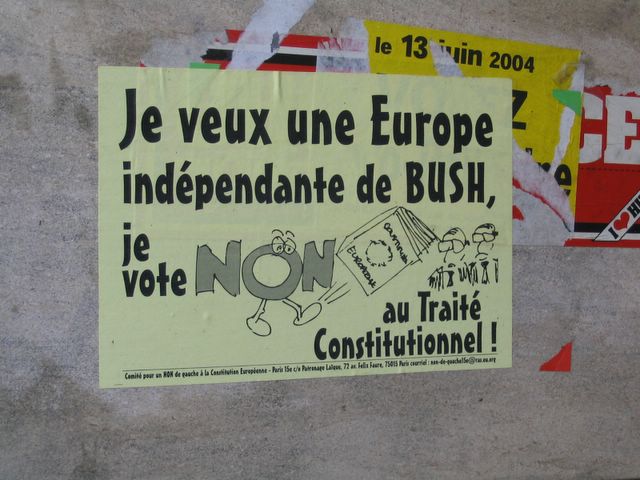
”graffiti”


John Rosenthal of Transatlantic Intelligencer reports that the proposed European Constitution is being attacked as an American Plot ™ and that the opposition is also an American Plot ™!

I tried to read the proposed constitution a while back, there seems to be an awful lot of noise for a constitution with 20 year shelf life. It is way to top heavy of on what should be legislative items. It contains extremely cumbersome procedures, which should keep lawyers in full employment. I hope the Charter of Human Rights is using formalisms common in Europe, which have well defined meanings, I’m not sure what it means in operational terms.

The European Union does need a good constitution. But if this one passes I hope they realize it is their own doing and not an American Plot ™.

Saturday, April 02, 2005

S(*(^%&^%$# Computers

It seems that TM Lutas of Flit TM is having a problem with 404 errors. Check it out.

Friday, April 01, 2005

Such a Night.

We wait for Karol Wojtyla to go home to his Savior. A great man in many ways, but he never forgot that he was called to be a priest; to bring Christ to the world. That he did. Everything else was secondary.

Pray for him in this hour of trial.

Saturday, March 26, 2005

He is Risen ! ! !

Rejoice, heavenly powers! Sing, choirs of angels!
Exult, all creation around God’s throne!
Jesus Christ, our King, is risen!
Sound the trumpet of salvation!

Rejoice, O earth, in shining splendor,
radiant in the brightness of your King!
Christ has conquered! Glory fills you!
Darkness vanishes for ever!

Rejoice, O Mother Church! Exult in glory!
The risen Savior shines upon you!
Let this place resound with joy,
echoing the mighty song of all God’s people!


V. Lift up your hearts.
R. We lift them up to the Lord.
V. Let us give thanks to the Lord our God.
R. It is right to give him thanks and praise.

It is truly right
that with full hearts and minds and voices
we should praise the unseen God, the all-powerful Father,
and his only Son, our Lord Jesus Christ.

For Christ has ransomed us with his blood,
and paid for us the price of Adam’s sin
to our eternal Father!

This is our passover feast,
when Christ, the true Lamb, is slain,
whose blood consecrates the homes of all believers.

This is the night when first you saved our fathers:
you freed the people of Israel from their slavery
and led them dry-shod through the sea.

This is the night when the pillar of fire
destroyed the darkness of sin!

This is the night when Christians everywhere,
washed clean of sin and freed from all defilement,
are restored to grace and grow together in holiness.

This is the night when Jesus Christ
broke the chains of death
and rose triumphant from the grave.

What good would life have been to us,
had Christ not come as our Redeemer?

Father, how wonderful your care for us!
How boundless your merciful love!
To ransom a slave
you gave away your Son.

O happy fault, O necessary sin of Adam,
which gained for us so great a Redeemer!

Most blessed of all nights, chosen by God
to see Christ rising from the dead!
Of this night scripture says:

”The night will be as clear as day:
it will become my light, my joy.”
The power of this holy night
dispels all evil, washes guilt away,
restores lost innocence, brings mourners joy;

It casts out hatred, brings us peace, and humbles earthly pride.
Night truly blessed when heaven is wedded to earth
and man is reconciled with God!

Therefore, heavenly Father, in the joy of this night,
receive our evening sacrifice of praise,
your Church’s solemn offering.

Accept this Easter candle,
a flame divided but undimmed,
a pillar of fire that glows to the honor of God.

Let it mingle with the lights of heaven and continue bravely burning to dispel the darkness of this night!
May the morning Star which never sets find this flame still burning:
Christ, that Morning Star, who came back from the dead,
and shed his peaceful light on all mankind,
your Son who lives and reigns for ever and ever.


Amen.


Exsultet - "The Proclamation of Easter" Easter vigil Mass

Friday, March 25, 2005

Passion


This is Holy Saturday, the saddest day of the Liturgical year; Christ has died, but is not raised. The Apostles, their leader crucified, at least one a traitor, scattered and hiding make their way back to the Upper Room. A tragedy too deep to understand the Savior’s words promising the Resurrection, that will come later, now is the loss of dreams and hope.

Thus it is a good day to comment on Mel Gibson’s Passion of the Christ. Even though there is a Resurrection scene it leaves us emotionally on Holy Saturday.

The story is easy to lose in the violence. Satan is confronting the Messiah, and throws all in his possession to defeat God’s Anointed and bring mankind totally into the void of evil. Violence upon violence is thrown to defeat Jesus by pain, despair, and hopelessness and finally death. The actions of the crowds and soldiers become more and more inchoate and violent. Satan is smirking more and more as the end comes near. Despite this some good remains, Mary Jesus’ mother, and Mary Magdalene, Veronica, Simon the Cyrine and ultimately the Centurion. But the violence goes on. - - - Finally Satan's victory, Jesus dies. - - - But wait - the tear of God washes clean. The temple veil is torn. The curses of the old law have been fulfilled. We see Satan cry in protest as he realizes he is defeated. On the third day, though the Apostles and disciples have yet to realize it, Christ will be Risen.


It is sometime said that the movie is an episode, not a story, and it should include more of the life of Christ, that this one episode does not give the full context. A reasonable comment from those who are not part of the Church. But I think that it is only an episode, the central episode, is how it should be seen. For in the Church the story of Christ is told throughout the year and the story of the Crucifixion is told in Lent and especially on Good Friday. In the Church the rest of the story of Jesus gives context to Good Friday, but even more importantly Good Friday and Easter give context to the rest the story.


The importance of this movie is not in Mr. Gibson’s heroic struggle to get it produced, or in the record box office that rewarded his efforts. The importance is that every year, even when the rest of the world has forgotten about it, in theaters, church basements, on home video, late night cable the Christian Church will be brought back to the Central story of the Christian faith. The rest of year, the story of Jesus no matter how well or poorly told will be presented in the context of the Crucifixion and Resurrection to reaffirm our faith, build our hope, and light the charity of Christ in our hearts.


While the movie described by some as a means of evangelization, I think it is more for the Catacombs, so that no matter how the Church may be scattered, until God in His grace restores her or Jesus comes again, the story of what Jesus did for us will be told with strength and clarity. For

Though Christ has died


On Easter Christ is raised

And Christ will come again!

Thursday, March 24, 2005

Forsaken


And about the ninth hour Jesus cried with a loud voice,
"Eli, Eli, lama sabach-thani?" that is,


My God, my God, why hast thou forsaken me?


Why art thou so far from helping me,
from the words of my groaning?

O my God, I cry by day,
but thou dost not answer;
and by night, but find no rest.

Yet thou art holy, enthroned on the praises of Israel.
In thee our fathers trusted; they trusted,
and thou didst deliver them.

To thee they cried, and were saved;
in thee they trusted,
and were not disappointed.


But I am a worm, and no man; scorned by men,
and despised by the people.
they make mouths at me, they wag their heads;

"He committed his cause to the LORD;
let him deliver him, let him rescue him,
for he delights in him!"

Yet thou art he who took me from the womb;
thou didst keep me safe upon my mother's breasts.

Upon thee was I cast from my birth,
and since my mother bore me thou hast been my God.

Be not far from me,
for trouble is near and there is none to help.

Many bulls encompass me, strong bulls of Bashan surround me;
They open wide their mouths at me,
like a ravening and roaring lion.

I am poured out like water,
and all my bones are out of joint;
my heart is like wax, it is melted within my breast;

My strength is dried up like a potsherd,
and my tongue cleaves to my jaws;
thou dost lay me in the dust of death.

Yea, dogs are round about me;
a company of evildoers encircle me;
they have pierced my hands and feet--

I can count all my bones-- they stare and gloat over me;
they divide my garments among them,
and for my raiment they cast lots.


But thou, O LORD, be not far off!
O thou my help, hasten to my aid!
Deliver my soul from the sword,

My life from the power of the dog!
Save me from the mouth of the lion,
my afflicted soul from the horns of the wild oxen!

I will tell of thy name to my brethren;
in the midst of the congregation I will praise thee:

You who fear the LORD, praise him!
all you sons of Jacob, glorify him,
and stand in awe of him, all you sons of Israel!

For he has not despised or abhorred the affliction of the afflicted;
and he has not hid his face from him, but has heard, when he cried to him.

From thee comes my praise in the great congregation;
my vows I will pay before those who fear him.

The afflicted shall eat and be satisfied;
those who seek him shall praise the LORD!
May your hearts live for ever!

All the ends of the earth shall remember and turn to the LORD;
and all the families of the nations shall worship before him.

For dominion belongs to the LORD,
and he rules over the nations.

Yea, to him shall all the proud of the earth bow down;
before him shall bow all who go down to the dust,
and he who cannot keep himself alive.

Posterity shall serve him;
men shall tell of the Lord
to the coming generation,
and proclaim his deliverance
to a people yet unborn,
that he has wrought it.


Good Friday
Mathew 27;46 and Psalm 22 RSVCE overlapping

Tuesday, March 22, 2005

Abraham Lincoln on Terri Schiavo

In those days, our Declaration of Independence was held sacred by all, and thought to include all; but now, to aid in making the bondage of the negro universal and eternal, it is assailed, and sneered at, and construed, and hawked at, and torn, till, if its framers could rise from their graves, they could not at all recognize it. All the powers of earth seem rapidly combining against him. Mammon is after him; ambition follows, and philosophy follows, and the Theology of the day is fast joining the cry. They have him in his prison house; they have searched his person, and left no prying instrument with him. One after another they have closed the heavy iron doors upon him, and now they have him, as it were, bolted in with a lock of a hundred keys, which can never be unlocked without the concurrent of every key; the keys in the hands of a hundred different men, and they scattered to a hundred different and distant places; and they stand musing as to what invention, in all the dominions of mind and matter, can be produced to make the impossibility of his escape more complete than it is.

Lincoln Douglan debate June 26,1857


Ok, he is talking about the Dred Scott decision. But with minor changes for gender and place to indict the guilty who could tell. At least Dred Scott was not starved to death.


Christopher Blosser does round ups better than any one. Check it out.

Sunday, March 13, 2005

Green is Good!

March 17th is Saint Patty’s day. So, except for beer, if it’s green it has to be good.

But I would think the sight of green meat, green cheese, green bread, and even green beer would have caused the holy monk and bishop to recommend prayer and fasting.

The Breastplate of St Patrick

I bind myself to-day
The strong Name of the Trinity,
By invocation of the same,
The Three in One and One in Three.
I bind this day to me for ever
By pow'r of faith, Christ's Incarnation;
His baptism in Jordan river;
His death on Cross for my salvation;
His brusting from the spicèd tomb;

His riding up the heav'nly way;
His coming at the day of doom;
I bind unto myself today.
I bind unto myself today
The virtues of the star-lit heaven,
The glorious sun's life-giving ray,
The whiteness of the moon at even,
The flashing of the lightning free,
The whirling wind's tempestous shocks,
The stable earth, the deep salt sea,
Around the old etrnal rocks.

Chirst be with me, Christ within me,
Christ behind me, Christ before me,
Christ beside me, Christ to win me,
Christ to comfort and restore me,
Christ beneath me, Christ above me,
Christ in quiet, Christ in danger,
Christ in hearts of all that love me,
Christ in mouth of friend and stranger.

I bind unto myself the Name,
The strong Name of the Trinity;
By invocation of the same,
The Three in One, and One in Three.
Of Whom all nature hath creation:
Eternal Father, Spirit, Word:
Praise to the Lord of my salvation,
Salvation is of Christ the Lord.


Source

Copyright 2004-2012 - All rights reserved. All opnions are mine, except comments or quoted material - who else would want them. Site Meter